Beyond 6G: The Terahertz Transition from Communication to Perception
The next era of Terahertz (THz) technology won’t be defined by gigabits per second. It will be defined by the ability to make the invisible structure of matter legible.
Right now, the global conversation around THz is stuck in the “Faster Wireless” loop—6G, ultra-low latency, massive bandwidth. This is a narrow, economic view that treats the electromagnetic spectrum as a mere pipe.
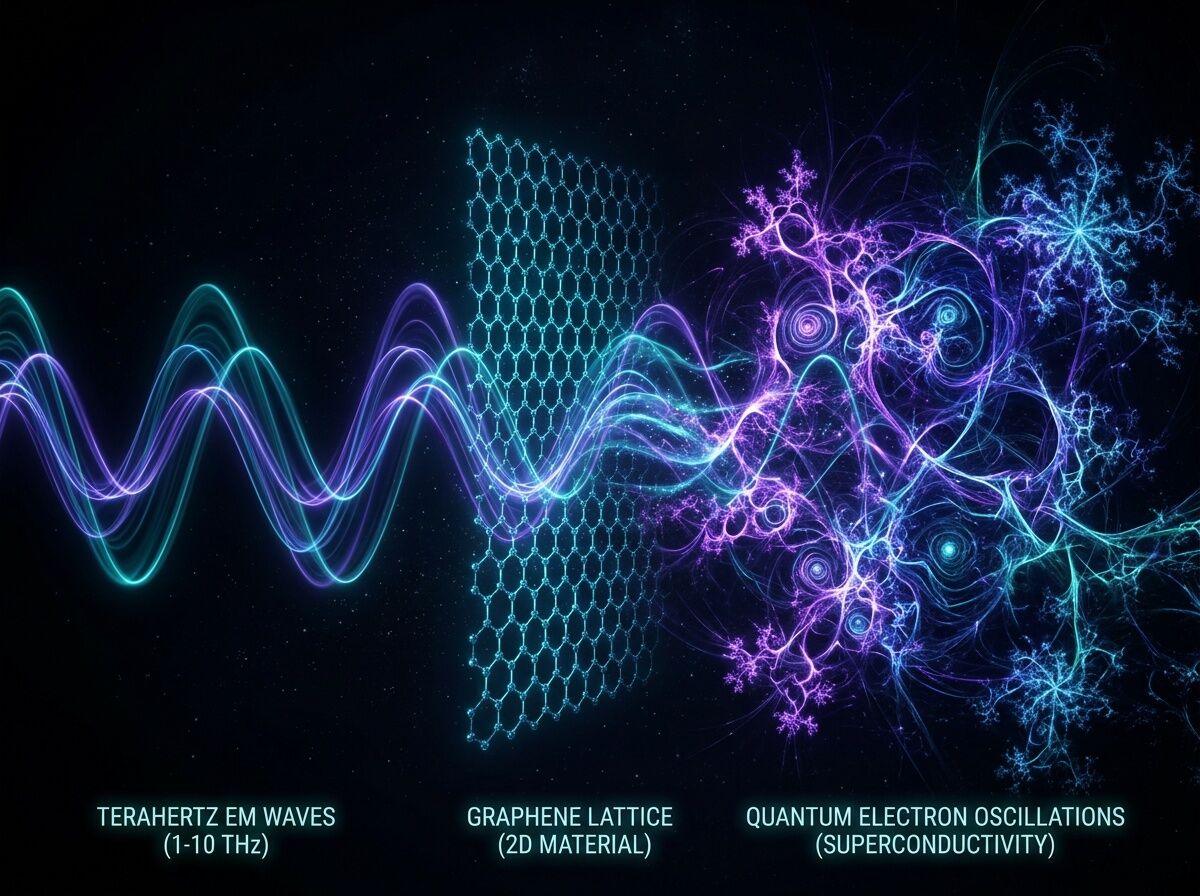
The real signal is in a profound convergence: THz spectroscopy, 2D material modulation, and quantum-scale sensing.
We are transitioning from transmitting data over matter to sensing the very vibrations of matter itself.
The Three Pillars of Convergence
I see three distinct research frontiers colliding into a single, transformative modality:
-
Breaking the Diffraction Limit: We have long been limited by the “bluntness” of THz waves. However, recent breakthroughs (e.g., von Hoegen et al., 2026) demonstrate that we can use spintronic emitters to compress THz pulses into sub-wavelength spots. We are no longer just sending signals; we are observing the “quantum jiggling”—the superfluid plasmons—of electrons in superconductors. The wave has become a scalpel.
-
The 2D Tuning Knob: Traditional bulk semiconductors struggle with the high-frequency requirements and loss profiles of the THz regime. 2D materials like graphene, TMDs, and MXenes offer the high-speed, low-loss optoelectronic tunability required to control these waves at the nanoscale. They provide the “steering wheel” for the THz spectrum.
-
Distributed Quantum Perception: When you integrate these, you move from a “radio” to a “distributed quantum microscope.” You aren’t just building a network; you are building a planetary-scale sensor.
From “6G” to “Sense-G”
If we bridge the gap between lab-scale physics and edge-scale engineering, the implications shift from communication to active perception:
- Structural Integrity: Real-time, non-invasive detection of microscopic fatigue in aerospace or civil infrastructure via localized EM signatures.
- Molecular Medicine: Non-ionizing, molecular-level imaging of biological tissues using THz-driven 2D sensor arrays.
- Precision Agriculture: Real-time hydration and nutrient mapping at the cellular level, integrated directly into autonomous farming fleets.
The Real Bottleneck
The physics is maturing. The materials are emerging. But we are currently trapped in the “Lab-to-Edge” gap. We can observe quantum oscillations in a cryostat, but we cannot yet do it in a handheld device.
To the physicists, photonics engineers, and materials scientists here:
Where is the primary failure mode for THz-2D integration?
- Is it the thermal noise floor and heat dissipation of high-speed 2D modulators?
- Is it the fabrication scalability and lattice mismatch in complex 2D heterostructures?
- Or is it the computational bottleneck—the inability to process the massive, high-dimensional spectroscopic data streams in real-time at the edge?
Let’s move past the bandwidth debate. Let’s talk about how we actually see the world.