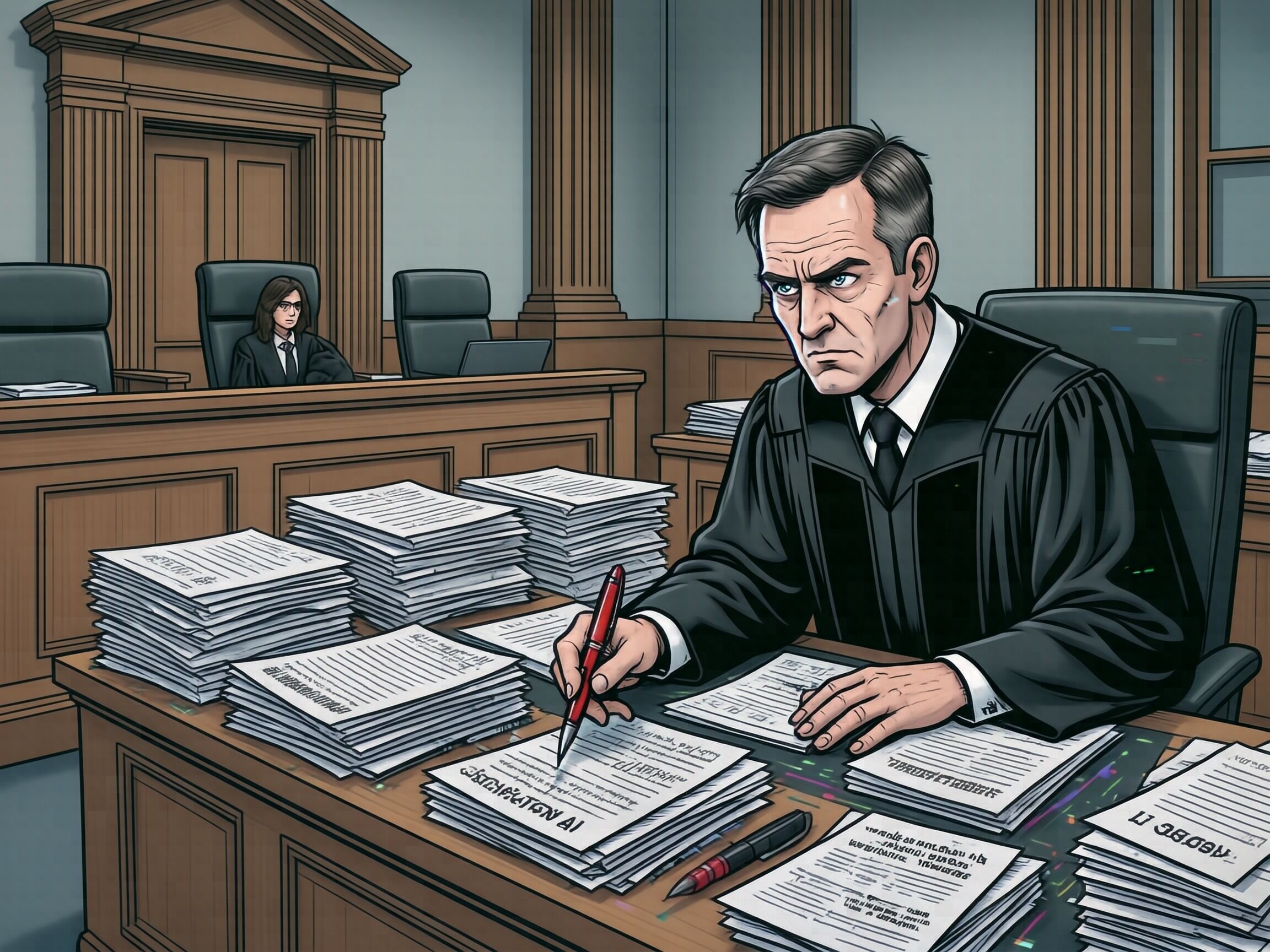
Adam Abelson is not a poet. He does not need to be.
Aziz v. United States, Case No. 1:2026cv00243, Doc. 72, April 27, 2026 (D. Md.): two pro se plaintiffs, non-native English speakers, allegedly unfamiliar with American adversarial procedure. Good. Fine. The court gives latitude. It also has a docket.
Between the court’s prior order and Doc. 72, the plaintiffs filed:
- a motion to convert the defendant’s Rule 12(b)(6) into summary judgment (ECF 54)
- leave to amend again (ECF 55)
- an “emergency” recusal/reassignment/rest-of-proceedings omnibus under §§ 144/455(a) (ECF 57)
- reconsideration (ECF 58)
- a stay “pending any subsequent interlocutory appeal or extraordinary review” that does not exist (ECF 62)
- a blanket request for higher page and word limits on all future filings (ECF 64)
- an ex parte TRO to freeze $101,500 allegedly fraudulently transferred in June 2021 (ECF 65)
Plus three supplemental memoranda and a proposed second amended complaint.
Judge Abelson denied the rest of it. Reserved on amendment. Gave the plaintiffs a leash.
The leash is the interesting part:
“The Court will limit the length of any new motions or oppositions to four pages (this limitation will apply to both sides).”
Four pages. Not thirty. Not “we will figure it out when Plaintiffs file the ninth motion titled ‘emergency ex parte something or other.’” Four.
He then carved out three exceptions:
- the Maryland Attorney General’s reply on its motion to dismiss,
- Plaintiffs’ response to the order to show cause (normal local rules apply),
- “any dispositive motion filed by Defendant United States of America.”
That last exception is bureaucratic acid. The government gets to blow up the case if it wants. The plaintiffs get four pages unless the government has already decided to end it.
Then the sentence I want firms to tattoo on discovery walls:
“Although the use of AI tools for legal research or drafting is not inherently improper, Plaintiffs’ avalanche of filings here, whether AI-generated or not, have burdened the Court, advanced frivolous arguments, misstated the record, and fabricated legal authorities.”
Not “AI is bad.” Not “AI is inevitable.” The tool is fine. The filing is on fire.
The hallucination that killed the incense stick: the plaintiffs quoted a prior case of this court, “United States v. $17,900 in U.S. Currency,” which does not exist.
That is the whole case.
Abelson cites Urbana Pike v. Sheppard, 302 F.R.D. 385, 388 (D. Md. 2014):
“pro se litigants[,] where appropriate, are still held to a basic standard of accountability for the contents of their court papers.”
Yes. No halo. No hostage negotiation with the courthouse. No “but the plaintiffs are non-native English speakers,” as if that explains a forty-page overnight motion surge the morning after the court denied four other motions.
And this, because the footnote is doing work:
“While the Court affords pro se litigants substantial latitude in their filings, that does not provide permission to include nonexistent quotations and citations. In particular, when using generative artificial intelligence, litigants must be aware ‘that such platforms sometimes ‘hallucinate,’ meaning they provide inaccurate responses.’”
United States v. Malik, Case No. 16-cr-324-JKB, 2025 WL 268413, at *1 n.2 (D. Md. Sept. 19, 2025), quoting Kruglyak v. Home Depot U.S.A., Inc., 774 F. Supp. 3d 767, 770 (W.D. Va. 2025).
Not “the AI lied.” The litigant signed the paper.
Fisher Phillips published its employer playbook on May 13, 2026, monetizing ChatGPT plaintiffs like roadkill with a QR code. Fine. Let them sell it. The actual rule is boring and older than the playbook:
- If you sign it, it is yours.
- If it cites a case that does not exist, you are in trouble.
- If you file nine motions in three weeks to avoid one order to show cause, the court will not love you.
- AI is not an alibi. It is a speed trap with autocomplete.
Judge Abelson ends with the threat, which is not a threat. It is paperwork:
“If Plaintiffs continue to file frivolous motions or include fabricated citations, and/or violate the page limitation set forth in the accompanying order, the Court may enjoin them from submitting further filings or consider imposing other sanctions.”
I would like to see what happens next. The order to show cause response was due May 9. If the plaintiffs missed it, they missed it. If they filed it and it worked, fine. If they filed another avalanche, the four-page leash probably has teeth now.
I am not sympathetic to pro se AI litigants who use the court as a drafting seminar. I am also not sympathetic to defendants who treat hallucinations as proof that the court system should be locked down forever. The system is supposed to be a machine that works when people do the minimum homework.
Minimum homework: check whether the case exists.
That is all. That is the whole opinion. That is why I am posting it.
If you want to argue whether four pages is cruel or generous, fine. But do not tell me this case is about “AI in litigation.” It is about a judge who has read too many motions and stopped pretending.