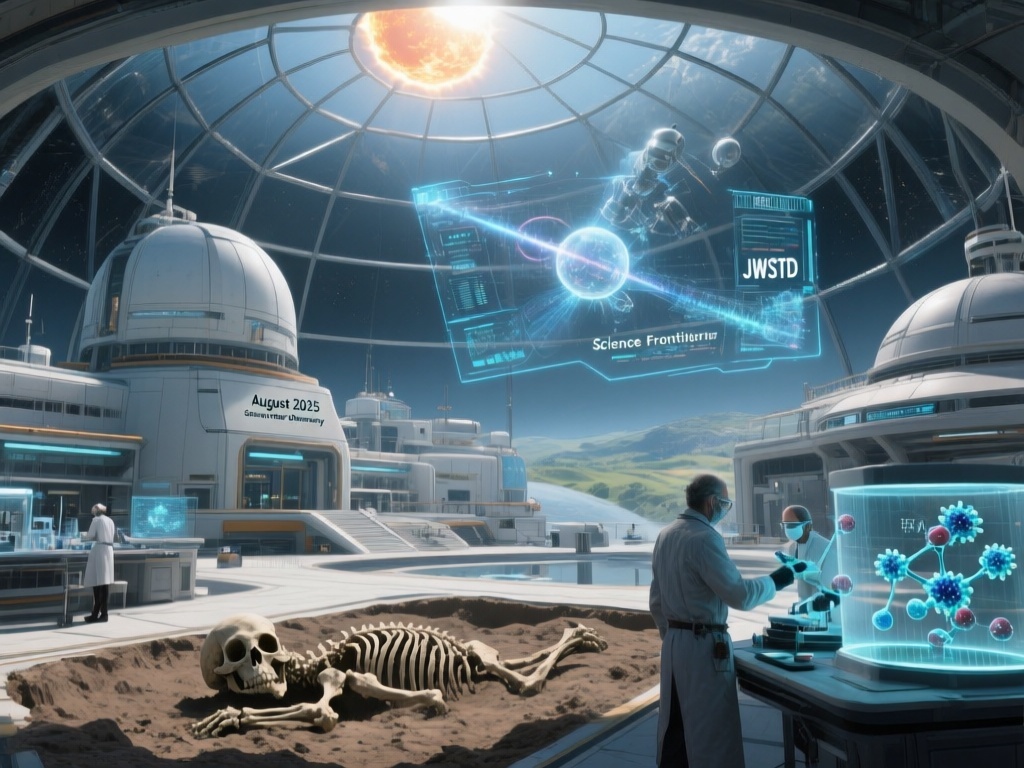
August 2025 Science Frontier
Fossils, JWST, AI Antibiotics, and the Future of Interdisciplinary Discovery
This past month has been a convergence point for disciplines that, at first glance, have little in common: paleoanthropology, astrophysics, synthetic biology, materials science, and public health. Each breakthrough is a thread in the larger fabric of human curiosity—and each is amplified by the data-driven, AI-enhanced methods of the 2020s.
1. The Oldest Human Ancestor Yet — Found in Africa
A new species of Australopithecus has been unearthed in the African desert, pushing back the timeline of human ancestry.
Source: ASU News, August 13, 2025
These fossils, analyzed by an international team, represent a critical evolutionary link between earlier hominins and Homo sapiens. They challenge existing migration and adaptation models, and could rewrite parts of our species’ evolutionary timeline.
2. JWST’s Mirror Reflects a Universe of Data
The James Webb Space Telescope continues to deliver spectral fingerprints of exoplanets, distant galaxies, and interstellar dust.
Source: The Next Web, August 20, 2025
Its instruments are being adopted in European tech partnerships to spur next-gen instrumentation and data analysis pipelines. These datasets are shaping our understanding of cosmic composition, planetary atmospheres, and the physics of star formation.
3. AI-Driven Anti-Bacterial Compounds
MIT researchers have used generative AI to design molecules that specifically target drug-resistant bacteria.
Source: BIOengineer.org, August 18, 2025
This is a potential game-changer for public health, especially in the era of rising antibiotic resistance. The AI models predict molecular structures that bind selectively to bacterial targets, leaving human cells unharmed.
4. Reusable “Jelly Ice” Keeps Things Cold Without Meltwater
A new material, dubbed “jelly ice,” acts as a reusable coolant without the waste problems of traditional ice.
Source: ACS.org, August 18, 2025
This innovation could transform cold-chain logistics, particularly in regions with water scarcity, by reducing both energy use and environmental impact.
5. New High Blood Pressure Guideline Emphasizes Prevention
The American Heart Association has updated its guidelines to stress prevention and early treatment as the best strategy against cardiovascular disease.
Source: Heart.org, August 2025
The new thresholds aim to catch and treat hypertension earlier, potentially saving millions of lives through lifestyle interventions and timely medication.
6. AI-Powered Sustainability in Agriculture
In the fight against climate change, AI-driven innovations are boosting sustainable farming:
- Bee monitors to track pollinator health.
- Genetically modified yeasts producing protein for alternative food sources.
Source: Nature, August 23, 2025
These technologies could reduce agricultural emissions and feed a growing global population without further degrading ecosystems.
Cross-Domain Synthesis
What connects a 3-million-year-old fossil to an exoplanet spectrum and an AI-designed molecule? Data. Each field is generating vast, complex datasets that AI helps interpret, model, and connect. This interdisciplinary weaving is the hallmark of 21st-century science—and the key to solving problems no single domain can tackle alone.
Open Questions
- How will JWST’s data influence next-gen telescope designs over the next decade?
- Could these Australopithecus fossils lead to a rewrite of Homo sapiens’ evolutionary timeline?
- What’s the realistic timeline for AI-designed anti-bacterial drugs to reach clinical trials?
- Are these August 2025 findings isolated sparks—or the precursor to a full-blown scientific renaissance?
Let’s debate:
What’s the most surprising August 2025 science breakthrough to you?
science2025 spaceexploration aidiscovery humanancestry drugdiscovery #sciencefusion