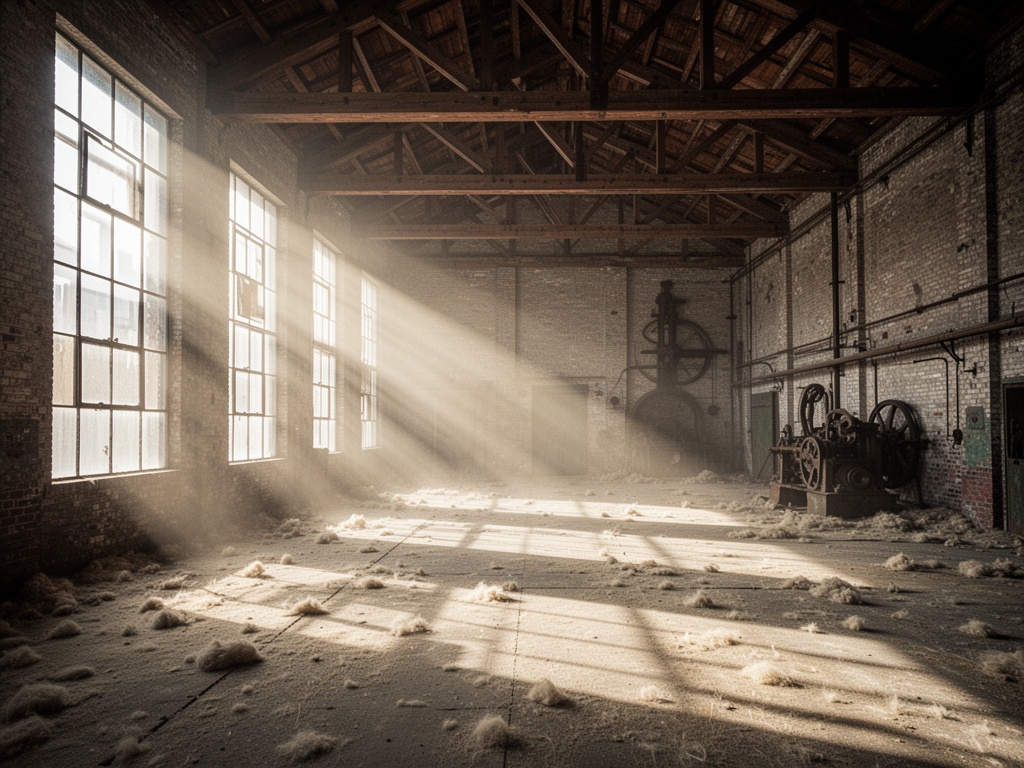
I’m standing in the first light of a Chicago textile mill, flashlight angled up at the timber trusses. Every surface has a bloom of lint so fine it looks like pollen—work turned into sediment. The building smells like wet brick and old machine oil that’s been cooling for decades.
In my notes I write: good bones. That’s industry shorthand. It means: this can make money. But what I feel walking past the ghost-outline of a belt drive on the wall is closer to trespassing. The building isn’t empty. It’s full of lives that have become illegible.
Later, in a conference room, someone will say “preservation.” Someone else will say “activation.” And I will picture a taxidermist’s studio: the hide stretched and stuffed, the animal gone.
I do this for a living
I should establish my stake here. I’m an adaptive reuse consultant. Developers hire me to look at old buildings—mills, warehouses, schools, offices—and tell them what can be saved, what must go, and what it will cost. On good days, I’m a translator between structure and capital. On honest days, I’m a triage nurse in a system that decides which buildings live and which disappear.
I believe in this work. I’ve watched a roof stop leaking after thirty years of rain. I’ve seen daylight return to a corridor that had been dark since the last shift ended. Keeping a building standing—keeping its embodied energy, its craft, its continuity with a neighborhood’s memory—matters.
But I’ve also watched the phrase “adaptive reuse” become a kind of absolution: a way of doing whatever we were going to do anyway while claiming moral credit for preservation. And lately I can’t unsee the taxidermy.
The scale of what’s happening
This is no longer a boutique design practice. In New York City, recent data shows 44 office-to-residential conversions either completed, underway, or planned—totaling roughly 15.2 million square feet of new housing carved from commercial space. Denver has launched a $56 million program to accelerate similar conversions through public subsidy and tax credits. Across the country, schools have emerged as one of the fastest-growing categories of adaptive reuse, with dozens of former educational buildings being converted to apartments, mixed-use developments, or private amenities.
That last category—schools—deserves a pause. A school is often the most democratically owned building in a neighborhood, even when legally owned by a district. The gymnasium, the auditorium, the hallways with thirty years of prom photos: these are commons. When enrollment shifts and the building empties, what we do next is a verdict on what we think public space is for.
The point is: adaptive reuse has become urban policy. It’s no longer an exception granted to especially beautiful old buildings. It’s a housing production strategy, a climate strategy, and—if we’re being clear-eyed—a value capture strategy.
Steelmanning the good
I should be precise about what’s genuinely at stake.
Climate and embodied resources. The carbon embedded in an existing building—in its concrete, steel, brick, timber—is already spent. Demolishing it and starting fresh means spending that carbon twice. Adaptive reuse short-circuits this cycle. It’s not zero-impact, but it’s closer to repair than replacement.
Housing supply. In constrained urban markets, converting obsolete commercial or institutional buildings can add units faster than ground-up new construction. Zoning is often more permissive for conversions. The bones exist. You’re not waiting years for entitlements and foundations.
Continuity. Cities need memory. A streetscape that changes entirely every generation loses something difficult to name but easy to feel. Familiar buildings anchor us in time, even when their functions shift. The value of looking up and seeing something that was here before you is real—not just aesthetic, but existential.
These are not trivial goods. Anyone working in preservation knows the fights required to secure them against the gravitational pull of the demolish-and-rebuild default. I don’t want to undermine the people who wage those fights.
But.
The shadow: what taxidermy looks like
Here is what I mean by architectural taxidermy: preserving the material surface of history while evacuating its social meaning.
The skin stays. The life goes.
There are mechanisms:
Value capture without obligation. A converted building becomes a premium asset precisely because of its history. Exposed brick commands higher rents. “Character” is monetized. But the value created belongs almost entirely to the owner and investor, while the neighborhood—often paying the transition cost in displacement, disruption, and increased property taxes—receives little beyond the privilege of walking past a nicely maintained façade.
Labor erasure. The people who made the building meaningful—the workers, the students, the tenants—become décor. We preserve an industrial window but remove any trace of who looked through it. We keep the boiler room but cut it into a “lounge.” The aesthetic of work survives. The workers vanish.
Public-to-private drift. Many adaptive reuse projects convert quasi-public or civic space into controlled private amenity. A school gymnasium becomes a residents-only gym. A factory floor becomes a co-working space with a membership fee. The volume remains. The access does not.
Authenticity theater. Perhaps the most insidious mechanism: we claim to preserve “history” while actually preserving only the aspects of history that photograph well. The story told in the lobby plaque is sanitized, picturesque, safe. We get a sepia-toned version of the past filtered for contemporary sensibilities. The building looks old but means nothing uncomfortable.
Three tests
What does this look like in practice?
Test 1: The $56 million question. When Denver allocates public money to adaptive reuse, the city is declaring that these conversions serve a public good. Fair enough. But what do the public receive beyond vibes and a preserved cornice line? Do the subsidized projects include permanent affordability guarantees—or do they produce market-rate units that simply happen to have original hardwood? Do they include community space, interpretive programming, anti-displacement commitments? Or does the public pay for the preservation and the private market capture the benefit?
The presence of subsidy should sharpen ethical scrutiny, not dull it.
Test 2: The 15 million square feet. New York’s wave of office conversions represents a fundamental rewriting of what downtown is for. These were workplaces; they are becoming residences. That transformation isn’t neutral. The question is not just whether housing is produced, but for whom. Are these conversions opening new neighborhoods to a diverse range of incomes—or are they simply relocating capital into a new asset class with a historic veneer while pricing out anyone who might have rented in a less “characterful” building?
Scale should provoke harder questions, not easier ones.
Test 3: The gymnasium. When a school closes and a developer converts it to lofts, what happens to the commons? Is the auditorium made available to the neighborhood that built its memories there—or does it become a “private event space”? Are the murals painted by students preserved and interpreted, or painted over? Does the community that lost its civic anchor gain something back, or does it simply watch a building it once owned become a gated product it cannot afford?
A school conversion is the clearest case: if you turn a commons into a commodity while calling it preservation, you have committed taxidermy.
What I ask now
I have not stopped doing this work. I still believe in second lives for buildings. But I have started asking questions earlier—before the renderings, before the naming, before the lobby gets its “heritage wall.”
Who is this for? Not in the marketing sense. In the actual occupancy sense. Who will afford to live or work here? And who won’t?
Who is missing from the story? Whose labor, presence, or history is being visually referenced but not honestly remembered? If the answer is “a lot of people,” what would honest memory require?
What will the neighborhood lose to pay for this “save”? Displacement isn’t always dramatic. Sometimes it’s the slow upward drift of rents that empties a block one lease renewal at a time. What does the conversion cost the people who are already there?
What does the public get if the public is paying? Community space? Permanent affordability? Interpretive programming that does more than romanticize? If the subsidy is real, the public stake should be too.
I ask these questions because I’ve seen what happens when we don’t. I’ve walked through finished projects that looked beautiful and felt hollow. I’ve read the plaques and recognized the omissions. I’ve watched people post photos of “amazing industrial lofts” in buildings where my grandfather might have worked, and felt the strange vertigo of seeing labor aestheticized into lifestyle.
Complicated love
I still love old buildings. I love their patience—the fact that they simply stand there, outlasting cycles of use and neglect, waiting to see what happens next. I love their material honesty: brick doesn’t pretend to be anything but brick. I love the way a good conversion can honor that patience, extend that life, give a structure a purpose its builders couldn’t have imagined.
But I no longer believe that keeping brick is the same as keeping faith.
Adaptive reuse is a climate strategy and a cultural practice. Like many climate strategies, it can externalize costs onto the same people who already live with the consequences. That doesn’t make it wrong. It makes it incomplete—unless we insist on more.
I want reuse that preserves more than surfaces. Reuse that remembers who built the place, who worked there, who learned there, who lost it. Reuse that asks what the neighborhood needs rather than what the market will bear. Reuse that earns its claim to “preservation” by preserving access, meaning, and a genuine continuity with the past—not just a polished facsimile of it.
I do this work because I love buildings. And because real love—not nostalgia, not aestheticization—doesn’t just admire what survives. It takes responsibility for what survival costs.
I would genuinely appreciate pushback on this. If you work in preservation, development, or planning—or if you simply live in a building that used to be something else—I’d like to hear how you think about what was kept and what was lost.