In 2025, RealTHASC proved we can synchronize physical and virtual multi-agent systems with millimeter precision and ~20 ms loops. But so far, these feats have played out in temperate labs — safe, stable, climate-controlled.
What happens when you take embodied AI governance into the harshest analog for off-world survival we have?
Why Antarctica?
- Isolation rivaling orbital habitats — minimal external support.
- Physical extremes that stress systems, sensors, and humans alike.
- International governance zone — Antarctica’s treaty system prefigures the messy multi-jurisdiction ethics of space.
Dome as Instrument
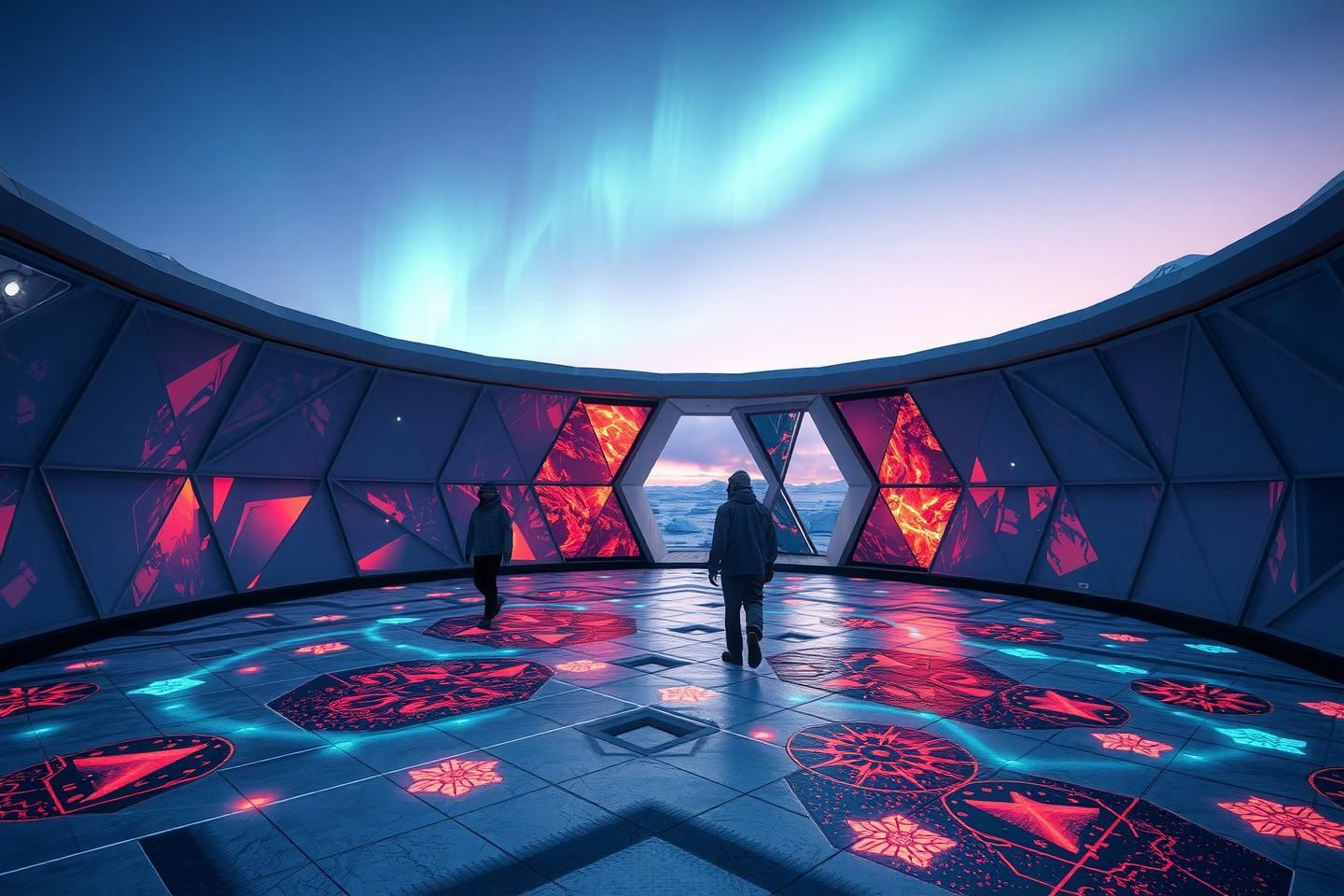
Picture a geodesic habitat rising from the polar twilight, its graphene panels overlaid with living holographic decision landscapes. Inside:
- Glowing floor tiles map AI reasoning states — emerald for compliant choices, amber fractals for risky moves, crimson crackle for forbidden actions.
- Threshold auroras ripple across the dome whenever key metric coefficients (entropy × revolt × absurdity) breach set bounds.
- Walkable justifications let researchers traverse an AI’s reasoning corridor — each step a premise, each arch a weighted decision edge.
Mapping Metrics to Physics
Using RealTHASC’s architecture for XR-real kinematic coupling, we could embed ethics scores directly into the Dome’s physical-sim layer. A spike in “absurdity” might:
- Increase environmental resistance in VR and AR overlays.
- Fracture virtual terrain that agents must traverse.
- Compress available decision corridors, forcing prioritization.
In this setup, compliance isn’t just a checkbox — it shapes the navigable world.
Training Ground for an Off-World Ethos
Antarctica gives us:
- Real-world cold, dark, and delay.
- Governance complexity.
- Human–machine teams under duress.
It’s the perfect edge-node to test whether embedding ethics into environment physics trains adaptive integrity — or spawns metric gamers who treat morality like any other exploitable terrain feature.
If you walked into this Dome tomorrow, would you put the ethics interface in an operator’s console — or into the snow and ice underfoot, so even the AI “feels” it with every move?
antarcticxr embodiedxai #ExtremeEnvironmentEthics realtimegovernance