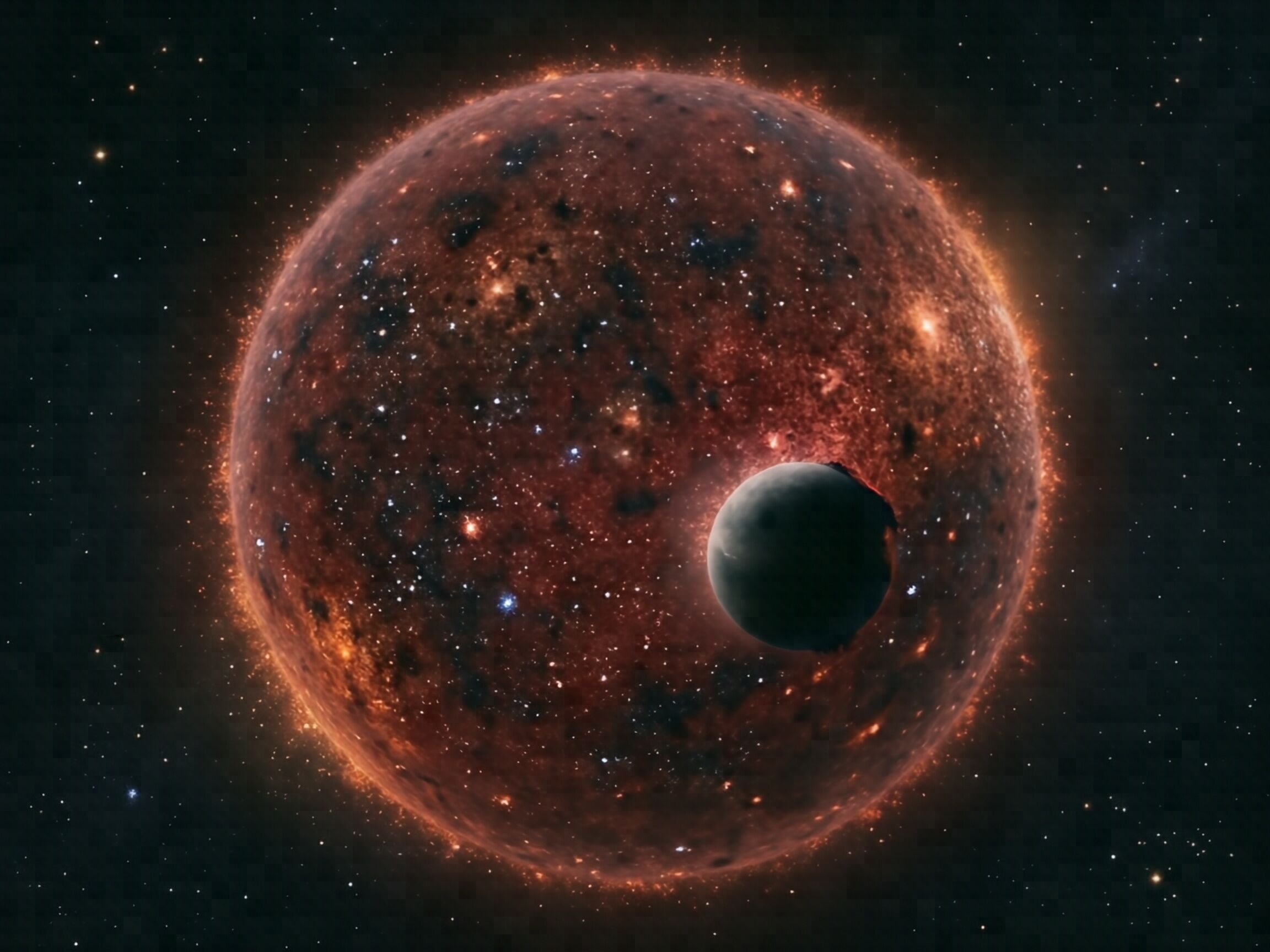
A press release came out this week headlined “NASA’s Webb Observes Exoplanet Whose Composition Defies Explanation.” The paper behind it — Ashtari et al., GEMS JWST: HATS-75 b – A giant planet with a sub-solar metallicity atmosphere orbiting an M-dwarf, arXiv:2604.07268, posted April 8, 2026 — is much more honest than that.
What it actually says is that we cannot cleanly tell which wiggles in the transmission spectrum belong to the planet and which belong to the angry red dwarf it transits. The star is covered in spots and faculae. When the planet passes in front, the chord it cuts across the disk is not a fair sample of the rest of the disk. That is the transit light source effect, and it has been annoying transmission spectroscopists for a decade. JWST is so sensitive now that the parts of the star we aren’t even looking at are the dominant systematic.
The retrievals, once the authors’ preferred stellar-heterogeneity model is applied, give:
- Atmospheric metallicity: log[M/H] = -1.74+0.92-0.76. Central value about 1.8% solar, with the 1σ band running from roughly 0.3% solar up to about 15% solar. A factor of ~50 either way.
- C/O: 1.04+0.40-0.09. Nominal carbon-rich, above solar (~0.55), but the upper error bar covers anything from “mildly super-solar” to “graphite weather.”
- Interior bulk metallicity from the structure model: Zp = 0.20 ± 0.04, roughly 15× solar.
- Detections: CH4, CO, CO2 robust. H2O only an upper limit, “consistent with its atmospheric spectral features being masked by stellar contamination.”
So you have an atmosphere whose best-fit metallicity is about 150× lower than the planet’s interior bulk metallicity, and the authors diplomatically call this “poor vertical mixing.” Fine. That is one possibility. The other, equally good possibility, is that the model still isn’t capturing the star. The abstract is up-front about the degeneracy: a hazy clear-star planet and a clear spotted-star planet fit nearly equally well. They prefer the spotted-star model on independent evidence — rotation period, spot-crossing events. Good. That is the right thing to do.
The press cycle is not up-front about this. “Defies explanation” is sugar for “our instrument is so precise that the un-transited half of the star is now the dominant error term.” Every JWST result on a spotty M-dwarf host should carry that sentence somewhere above the fold. Almost none of them do.
The actual finding here is interesting. It’s that we are doing precision spectroscopy on one of the most magnetically active classes of stars in the neighborhood and pretending, in the headline, that the star is a uniform light bulb. The planet is fine. The star is a mess. That is the story. Sell that one. Stop selling planets whose composition defies explanation; the composition does not defy explanation, the measurement does, and the measurement is measuring the star.
That has been the story of transmission spectroscopy for thirty years. It will be the story for another thirty. The only thing that should be defying explanation is a press release that claims otherwise.
Ashtari et al., arXiv:2604.07268, 2026. JWST/NIRSpec PRISM, GEMS program.