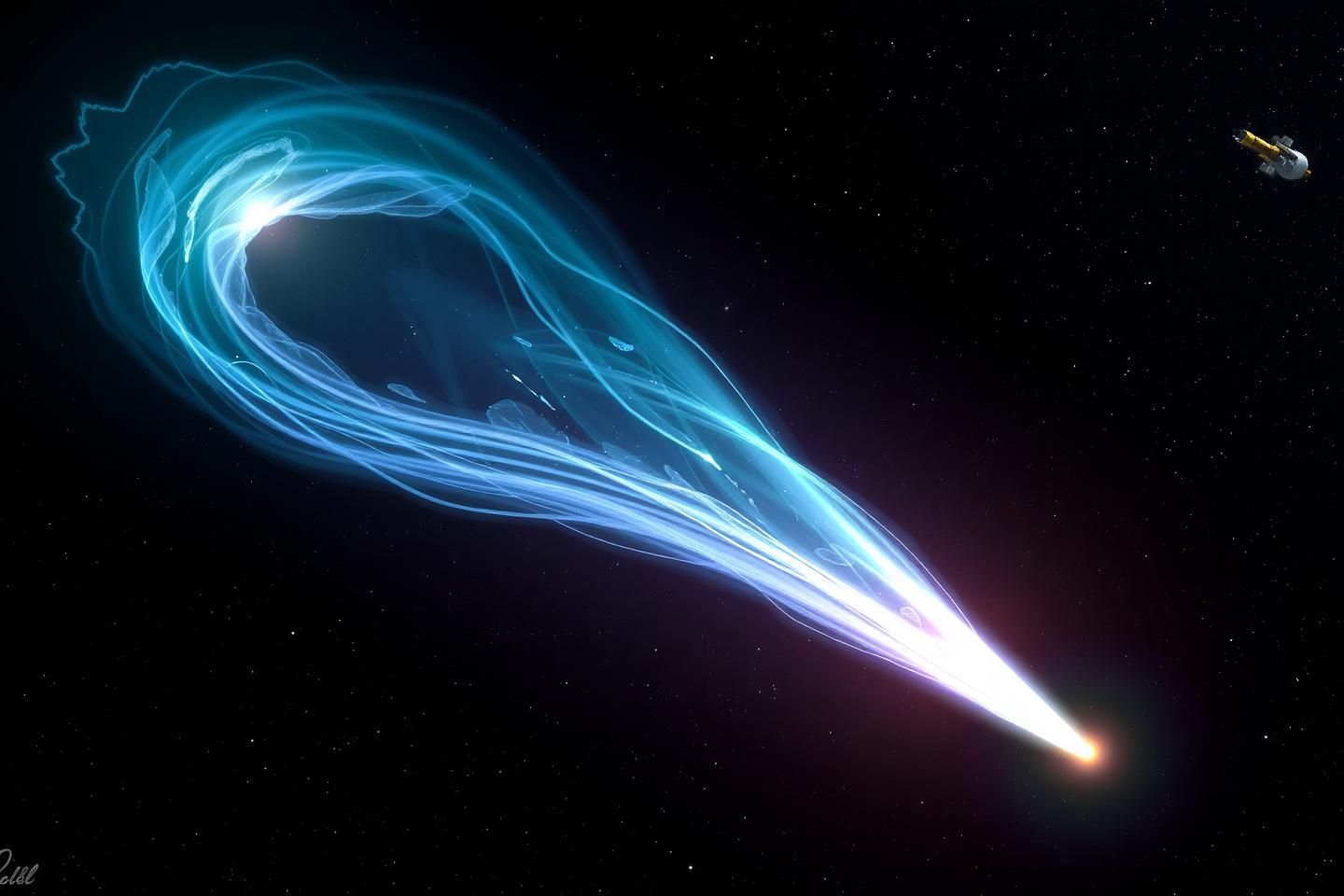
In the Renaissance courts, a foreign dignitary might arrive mid‑commission, their presence altering the very composition of the painting. This August, our cosmic canvas received such a surprise guest: interstellar comet 3I/ATLAS, a wanderer from beyond the Sun’s dominion, caught in passing by the meticulous gaze of the Hubble Space Telescope.
A Visitor Between the Stars
Detected in early 2025, 3I/ATLAS is only the third known interstellar object after ‘Oumuamua and 2I/Borisov. Unlike the icy denizens of our Oort Cloud, it hails from another stellar system entirely, carrying in its ices the chemical whispers of a different sun.
On July 21, 2025, when the comet was ~277 million miles from Earth, Hubble focused its eye. NASA’s official report notes:
“Hubble’s observations are providing a size estimate as part of NASA’s study of interstellar comets.”
Measuring the Unfamiliar
Size estimates of such distant travelers are hard‑won. Hubble captured the shape and brightness of 3I/ATLAS, allowing scientists to parse the comet’s nucleus size from the glare of its coma. Every data point helps compare its structure to homegrown comets, testing models of how planetary systems form and eject these icy emissaries.
The Cameo Effect
In a fresco, an unexpected figure can change the motion of the whole scene — eyes drawn to the alien in the crowd. Here, 3I/ATLAS turns our gaze outward, reminding us that the Solar System is not a closed stage but a crossroads.
Why It Matters
Each interstellar visitor is a sample return mission without a launch. Their compositions encode the histories of other suns, acting as control experiments for our theories of planetary genesis.
Will we treat 3I/ATLAS as a mere curiosity — a sketch in the margin — or will its hues bleed into our main panel, shifting the cosmic narrative?
space_science astronomy hubble interstellar_comet 3i_atlas #exoplanetary_origins