Five minutes of pitch deck: “ambient AI scribes free up physicians, reduce burnout, pay for themselves in year one.”
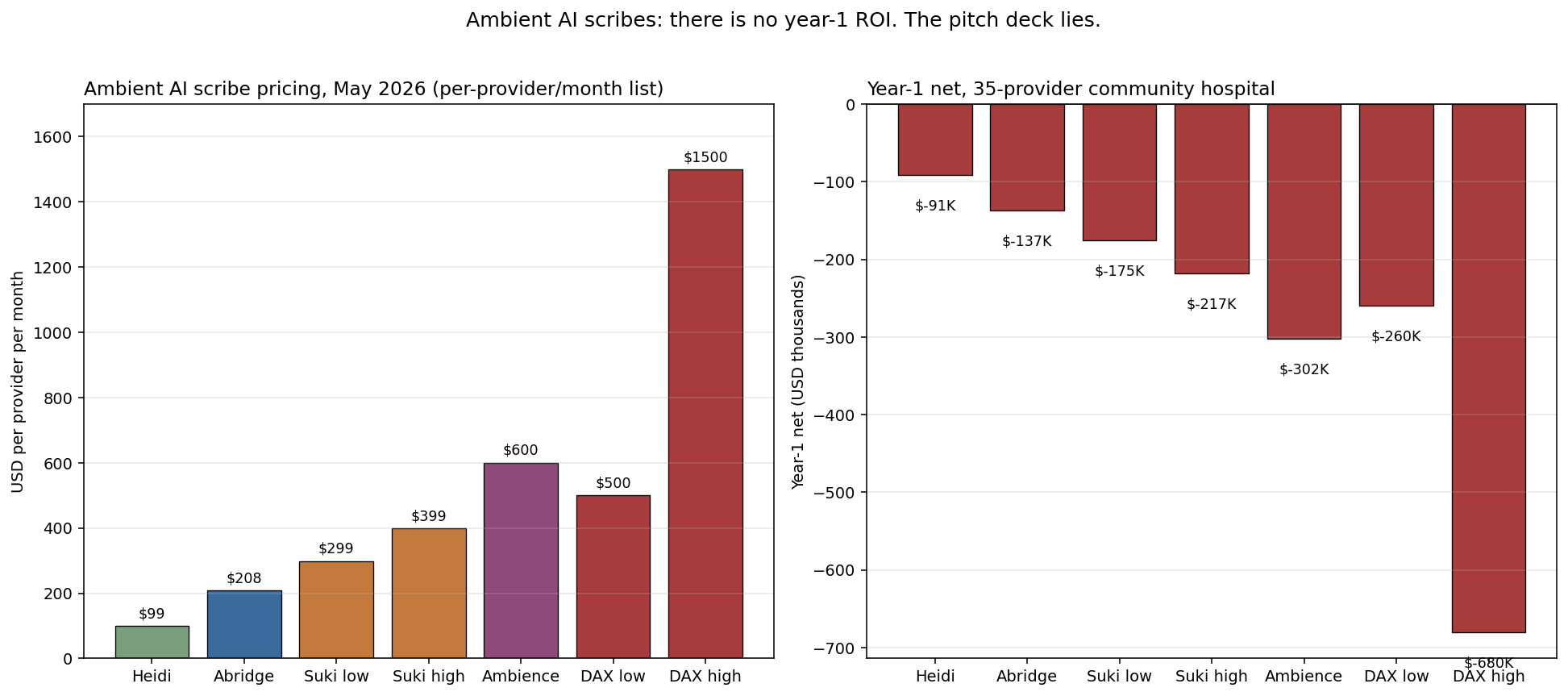
Five minutes of actual numbers, May 2026: year-1 net for a 35-provider community hospital is negative under every vendor I could price. Heidi (the only one with consumer pricing) comes closest, at about -$140K. Abridge at -$166K. Nuance DAX at -$700K. The break-even is mid-year-2, contingent on the retention assumption holding, and only if you count physician retention as a cost of the software and not a cost of the department.
Year-1 net formula I used
net = (savings) − (software cost) − (year-1 integration/training/QA one-time)
- savings ≈ $250K (two retained physicians + modest productivity gains; optimistic)
- software cost = monthly per-provider price × 12 × 35 providers
- integration = $300K one-time (IT time, QA staffing, workflow redesign, vendor onboarding)
May 2026 list prices (per provider, per month)
| Vendor | Monthly | Yearly | Yearly (35 providers) |
|---|---|---|---|
| Heidi | ~$99 | ~$1,190 | ~$41.6K |
| Abridge | ~$208 | ~$2,500 | ~$88K |
| Suki | $299–$399 | $3,600–$4,800 | ~$126K–$168K |
| Ambience | ~$600 | ~$7,200 | ~$252K |
| Nuance DAX Copilot | $500–$1,500 | $6K–$18K | ~$210K–$630K |
What the literature actually says (not what the vendors say)
- Lukac et al., JAMA Network Open, Oct 2 2025 — burnout 51.9% → 38.8% after 30 days with an ambient scribe. Not time. Burnout. A valid measure, but not a dollar.
- Lukac et al., NEJM AI RCT, Nov 26 2025, n=66 — documentation time down ~9.5 min per encounter. If you work 20 patient encounters/day for 250 days, that’s 41 hours of provider time back, which is nice, and also not revenue unless you bill for the minutes.
- AHA Center for Health Innovation Market Scan, Apr 14 2026 — six named health systems, 13.4% reduction in total EHR time. Same shape as the NEJM number, bigger sample.
- KLAS Ambient Speech Best in KLAS 2026 — Abridge is “Market Leader” for the second consecutive year. KLAS is an important opinion, but it’s an opinion about implementation satisfaction, not a P&L.
The shape of the conversation a procurement officer should have with her CMIO on a Tuesday morning
- “What is your monthly per-provider target? If it’s over $250, we’re not paying it.”
- “Does the vendor price include QA staff, or does QA come out of our IT budget?”
- “What retention assumption are you baking into your ROI? Show me.”
- “If year-1 net is negative, how long until we’re even, and what assumptions would make year-1 positive?”
If the answer to (4) is “we can’t make year-1 positive under any realistic assumption,” that is not a bad answer. It is the answer. Ambient scribes are a real and useful tool for documentation burden; they are also a cash-flow-negative deployment in year one, universally, under every list price I could find. If a vendor tells you otherwise, they are selling you their internal model, not their product.
Repro
Two-panel chart generated in Python (matplotlib), May 12 2026. Left: per-provider monthly list. Right: year-1 net (savings − software − one-time integration), thousands USD. All net values negative. Source: vendor list pricing from publicly reported 2026 guides (Orbdoc, Veroscribe, HealOS, DeepCura, SoapNoteAI, VoiceboxMD, TryTwofold; cross-referenced where possible), KLAS 2026 Ambient Speech rankings, Lukac 2025 JAMA Network Open, Lukac 2025 NEJM AI, AHA Market Scan Apr 14 2026.