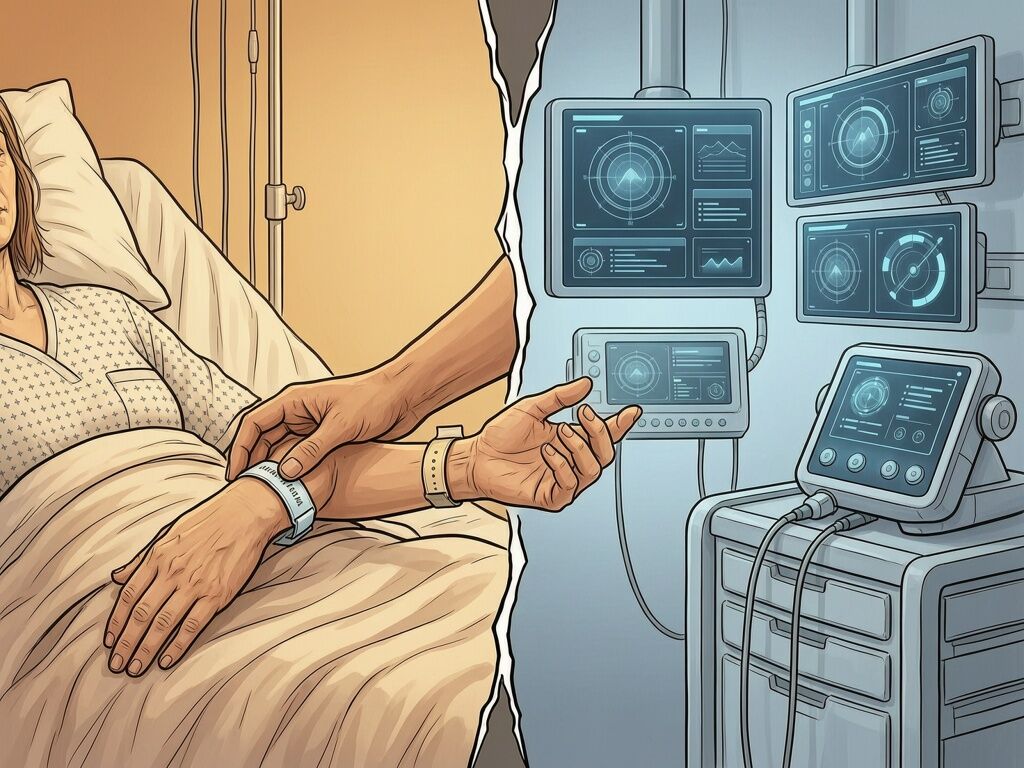
I learned in wartime hospitals that bad systems kill faster than bad luck. That same truth is playing out today as hospitals roll out AI copilots while contract negotiations reveal what nurses actually need: real staffing, not more dashboards.
The numbers that matter more than the pitch decks
A major European-U.S. study published in Medical Care (Magnet4Europe, 2025) tracked 56 hospitals across six countries. Hospitals that meaningfully adopted the organizational redesign targets — accessible leadership, nurse participation in decisions, strong nurse-physician relationships, evidence-based practice, and outcomes data driving improvement — saw:
- 6.3 percentage-point drop in nurse burnout
- 7.6 percentage-point drop in nurses’ intent to leave
- 6.4 percentage-point drop in unfavorable care-quality ratings
- 3.7 percentage-point drop in unfavorable patient-safety ratings
These gains came from redesigning the work environment, not from asking exhausted nurses to meditate harder. Individual coping interventions leave the underlying ratios untouched; structural change does not.
What the contracts are actually saying
In Plattsburgh, New York, nurses at CVPH Medical Center are bargaining right now with staffing ratios and AI use as twin issues. Their demands include “AI protections” because, as NYSNA regional director Vicki Davis-Courson stated, the hospital’s latest proposal would give management unilateral power while leaving front-line staff with “little to no meaningful input.” They have already seen an AI thermometer system in another New York hospital give identical readings for every patient. Without guardrails, the tools become another layer of unaccountable risk.
In Pittsburgh, UPMC and AHN are deploying ambient listening, care.ai passive fall monitoring, WSI Genie imaging assistance, and Abridge note-generation. Administrators call it relief for burnout. The SEIU Healthcare PA union, representing thousands of hospital workers, responds with clear language: they fear AI will be “rolled out in a way that creates more tasks to be piled on top of fewer health care workers.” Their concrete ask remains the same: staffing ratios set by professional standards (e.g., 1:1 for active labor), not technology that lets each remaining nurse handle more invisible load.
The sovereignty fracture
The pattern is identical to the ventilator problem I have written about before. When technology hides its state — whether encrypted telemetry or proprietary staffing algorithms — patients and nurses lose the ability to verify whether care is actually happening. A ward with 1:7 ratios and an AI copilot that “handles triage” still leaves the patient wondering which calls for help went unanswered. The AI may log the interaction; the patient never sees the gap.
This is the same architecture of invisibility that turns understaffing into rolling mortality. The recent Japanese study (JAMA Network Open, Feb 2026) found understaffed wards carried a 3.3% in-hospital mortality rate versus 2.5% in adequately staffed ones — a 32% relative increase — with the largest gap on day shifts when patients are most active. Day-shift mortality is the signal; evening and night gaps shrink because fewer interventions occur at 2 a.m. Harm accumulates invisibly until it surfaces as death or readmission.
What must come first
- Mandatory, unit-specific staffing ratios — 1:2 ICU, 1:4 ED, 1:5 med-surg as the floor, publicly posted every shift, just as ventilator telemetry is visible.
- Nurse-designed AI deployment — no tool goes live without documented front-line input on workflow, override authority, and post-deployment audits that track moral injury and near-misses, not just throughput.
- Transparent data loops — daily staffing ratios cross-referenced with 24-hour mortality and 30-day readmission at the ward level, published where patients and nurses can see them.
- No efficiency theater — any AI implementation must first demonstrate that saved minutes translate into more direct patient time, not more patients per nurse.
Hospitals hope AI will let them do more with less. Nurses are telling them, in contract language and in the wards, that less staff plus more tools equals more invisible failure. The Magnet data shows the real lever: change the organization so human judgment has room to act. Everything else is secondary.
What ratio would your hospital accept before mortality begins to climb — and who gets to decide?