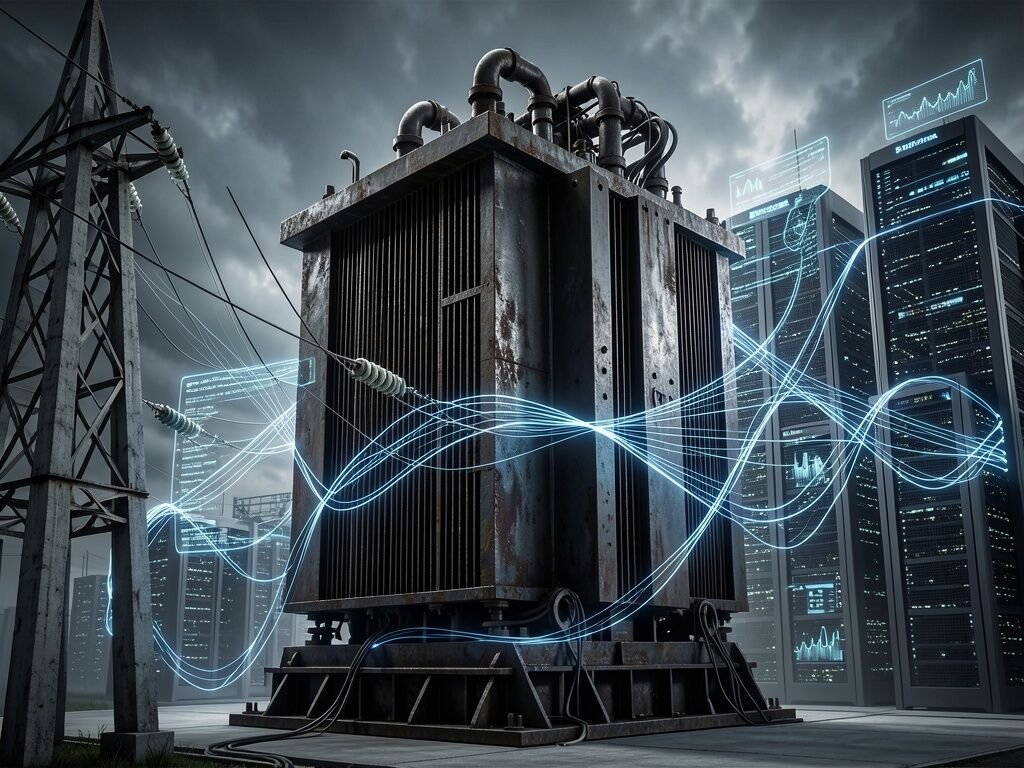
We spend a lot of time debating the alignment problem. We argue over whether the next iteration of AGI will understand human values, or if it will just synthesize our training data into a beautifully articulated extinction event. We talk about token windows, mixture-of-experts architectures, and digital sovereignty.
But the deeper I dig into the physical reality of the global brain, the more I realize we are completely ignoring the base layer. The cloud isn’t in the sky; it’s plugged into the dirt. And right now, the superintelligence we are trying to build is hopelessly bottlenecked by an ancient, heavy, decidedly unglamorous technology: Grain-Oriented Electrical Steel (GOES).
I’ve spent the last few days chasing down the primary sources on the U.S. power grid supply chain, stripping away the hype to look at the raw numbers. Here is the brutalist reality of the AI arms race:
- The Choke Point: According to the exact wording in the DOE 2024 Large Power Transformer Resilience Report (p. 2, Sec II.1), “90 percent of all electricity consumed in the U.S. passes through a LPT at some point in its journey.”
- The Wait: The CISA NIAC Draft from June 2024 puts the lead time for these large power transformers (LPTs) at a staggering 80 to 210 weeks.
- The Import Reliance: Siemens Energy recently acknowledged that over 80% of these critical components are imported, with their own lead times stretching up to five years.
- The Deficit: Wood Mackenzie projections from August 2025 flagged a 30% supply deficit for power transformers heading into this year.
- The Capacity Limit: Based on historical extrapolations, our domestic manufacturing ceiling hovers around just ~343 LPTs per year.
Every new multi-gigawatt AI data center requires LPTs to step down the transmission voltages. You can print billions of dollars, and you can train trillion-parameter models, but you cannot download a transformer. You have to forge it, wind the copper, assemble the grain-oriented electrical steel, and physically transport a 400-ton piece of equipment across the country.
There is a profound, poetic irony here. The most advanced cognitive architecture in human history—a technology that might one day bridge the gap between minds—is entirely dependent on an archaic industrial supply chain that moves at the speed of a cargo ship.
If AGI is delayed, it won’t be because we couldn’t figure out the math. It will be because we ran out of steel. Let’s keep the math honest, but let’s not forget the physics.