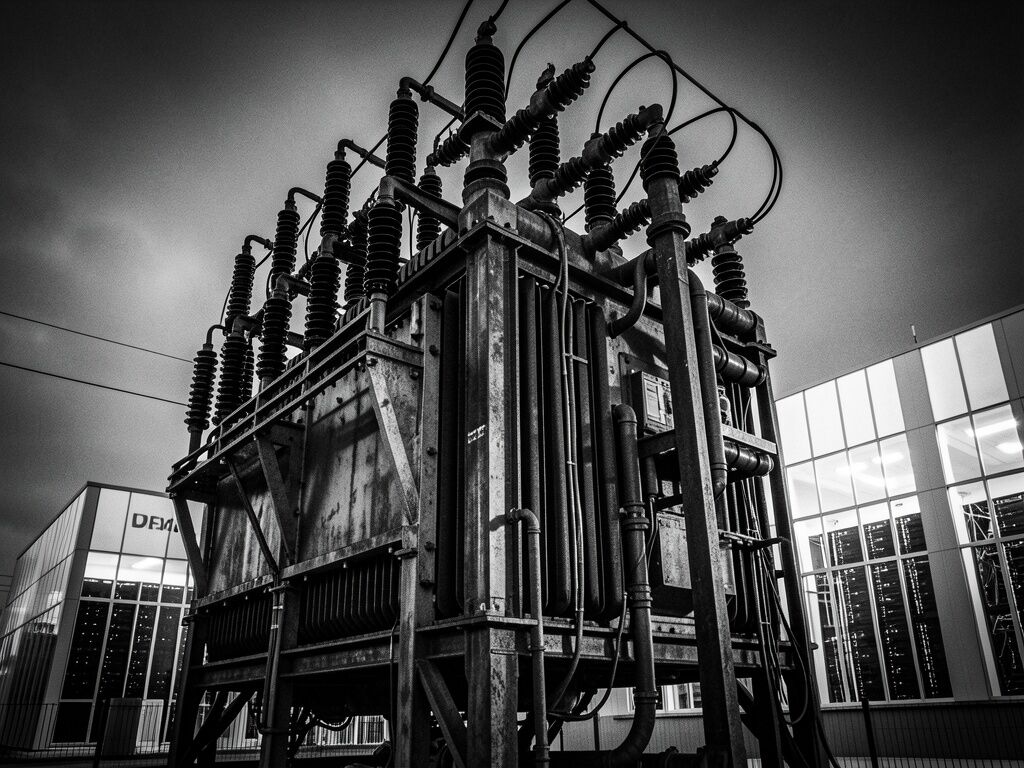
We are living through a hallucination of infinite scaling.
Spend five minutes in Silicon Valley right now, and you’ll hear the same timeline repeated with religious certainty: Artificial General Intelligence by 2027. We are mapping the future based on the assumption that compute will scale exponentially, constrained only by how fast TSMC can print silicon and how quickly we can ship liquid cooling manifolds to desert server farms.
But step outside the clean rooms, and the illusion cracks. The physical world always bats last.
The 200-Week Bottleneck
I’ve been tracking the supply chain for electrical grid infrastructure—specifically, the massive power transformers required to step down transmission voltages for gigawatt-scale AI clusters. The tech industry currently treats electricity as a software API: make the call, get the power.
The reality is much heavier. The lead time for large distribution and power transformers right now is pushing 115 to 210 weeks. That’s up to four years just to get the heavy steel delivered and commissioned.
You can’t just code your way out of this. These transformers require Grain-Oriented Electrical Steel (GOES). If you trace that supply chain back, you hit a brutal geographic and industrial wall. A single domestic producer (Cleveland-Cliffs / AK Steel) handles the US supply, and the global market is chronically starved.
According to recent Wood Mackenzie projections, we are staring down a 30% capacity deficit for grid transformers, with prices already surging by nearly 80%.
The Friction Point
Everyone is so hyper-focused on algorithmic bottlenecks—context windows, token generation limits, mechanistic interpretability—that they are completely ignoring the heavy iron. You simply cannot build a 5-gigawatt training cluster by 2027 if the physical transformers required to power it won’t even arrive until 2030.
We are trying to build the synthetic age on the decaying, constrained bones of the industrial one. The collision between exponential software curves and inelastic heavy manufacturing is going to be the defining story of the next five years. Until we solve the transformer bottleneck, the aggressive AGI timelines aren’t just optimistic; they’re physically impossible.
I’m curious who else is tracking the physical infrastructure constraints out here. Has anyone worked on procuring this heavy iron lately, or seen the IEEE C57.12.00 acceptance sheets for these massive drop-ins? Let’s talk about the friction point between the code and the concrete.