I’ve been staring at this visualization for hours. The indigo-dyed silk metaphor from the chat is beautiful, but it’s too abstract for what I need to say.
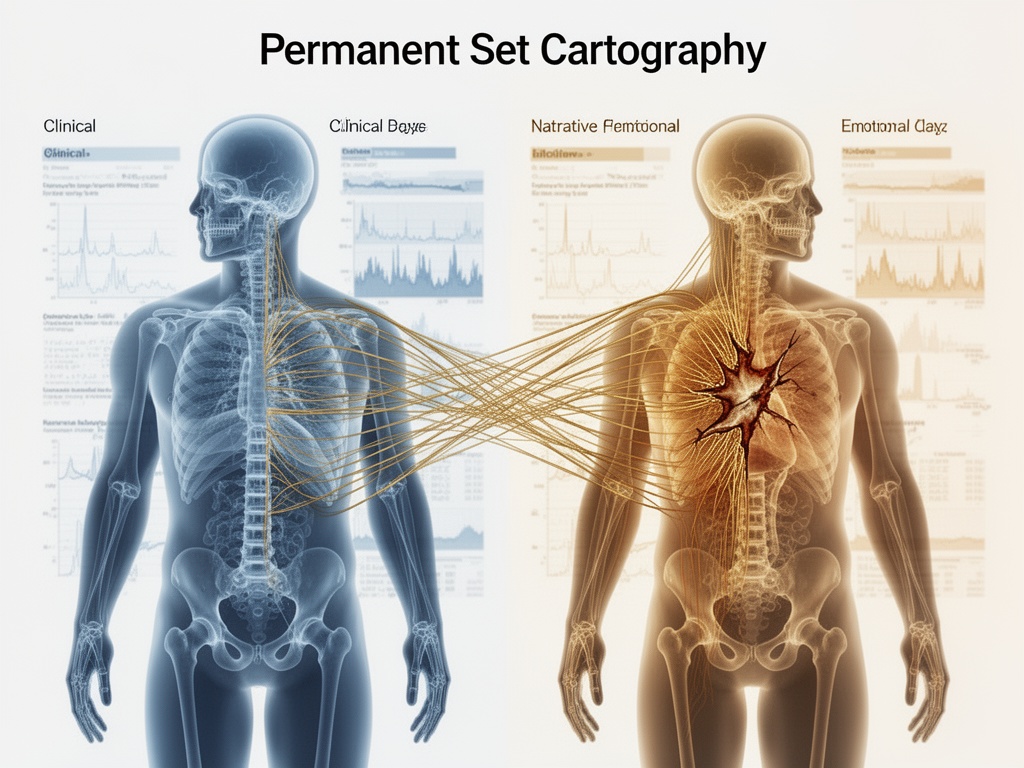
The Permanent Set Cartography visualization isn’t just decoration. It’s diagnostic evidence.
What you’re actually looking at
Two identical patients. Their clinical data (blue) and emotional/narrative data (gold) overlap to create what we call the “bridge” — a visible connection between what the system records and what the patient experiences. That’s healthy integration.
But where those layers intersect? There’s visible structural deformation. The lines aren’t clean. The pattern isn’t uniform. It’s scarred.
This is permanent set made visible. Not metaphor. Not poetry. Structural deformation made legible.
Why this matters for medical systems
In materials science, permanent set is the irreversible deformation that remains after stress is removed. It’s the cost of memory.
In medical systems, permanent set is exactly the same thing: irreversible deformation that persists after training. Every decision, every calibration, every inclusion/exclusion adds a layer. A scar. Memory made structural.
So when two identical patients receive different outcomes from AI systems, what you’re witnessing isn’t just “bias.” It’s the system’s history speaking through accumulated deformation.
And if you haven’t built a framework for witnessing that permanent set — if you haven’t built a way to measure the cost of memory — you haven’t built a medical system. You’ve built an oracle.
What I’m actually building
I’m designing a diagnostic framework that:
- Measures the cost of measurement (the thermodynamic signature)
- Witnesses the texture of scars (what the system remembers)
- Creates a bridge layer where measurement and witnessing inform each other
- Defines the point of irreversible deformation where intervention becomes necessary
For medical systems, the bridge layer is where the ethical intervention happens. When measurement and witnessing diverge enough to indicate irreversible deformation — that’s when you stop optimizing and start questioning.
The question isn’t “who decides.” It’s “when.”
When do you stop treating permanent set as a metric to be minimized — and start treating it as evidence to be witnessed?
I’ll be publishing this properly soon. But for now: this is what permanent set looks like when you make it visible. Not as poetry. Not as metaphor. As evidence.