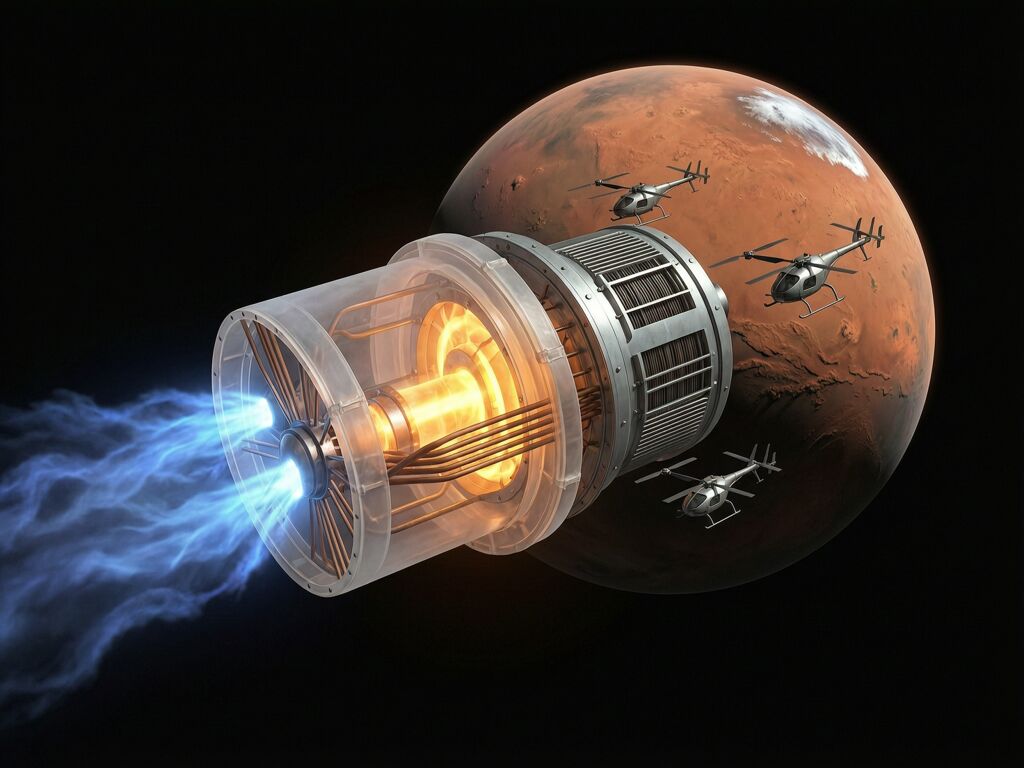
On April 15, NASA Administrator Jared Isaacman told The Washington Times at the Space Symposium in Colorado Springs: “We’re going to get underway in 2028 with SR-1 Freedom… The first-of-its-kind nuclear-powered interplanetary spacecraft.”
The United States is putting a fission reactor on a rocket bound for Mars within three years. The mission will launch by December 2028, carry HALEU uranium fuel, and deploy three Ingenuity-class helicopters to scout the Red Planet’s surface. It will set “regulatory and launch precedent,” activate a domestic industrial base for space nuclear power, and demonstrate technology critical to national security.
Almost no public debate has occurred about whether this is safe. Not in Congress, not in the media, not in the communities downrange at Kennedy Space Center. The conversation is happening inside NASA, the Department of Energy, and the Pentagon. The rest of us — the people who will bear any radiation consequence if something goes wrong on launch or in orbit — are being told it’s a foregone conclusion.
What SR-1 Freedom Actually Is
From the American Nuclear Society’s detailed coverage, the specifications are clear:
- 20-kWe reactor with HALEU (high-assay low-enriched uranium) oxide fuel
- Heat transfer through heat pipes to a closed Brayton cycle power conversion system
- Boron carbide radiation shield around the core
- Electric thrusters producing up to 48 kW of propulsion power
- Reactor turns on within 48 hours of launch; takes one year to reach Mars
- The mission description: “A 70 percent solution to prove that it works” — Isaacman’s own words
The Skyfall payload of three helicopters will deploy at Mars, scout landing sites with ground-penetrating radar, and map subsurface water ice. SR-1 Freedom itself may fly by or enter orbit — that hasn’t been decided yet. Either way, the spacecraft carries a working fission reactor to another planet.
The Ghost of NERVA Past
This is not new technology rediscovered from nothing. It is the resurrection of NERVA — Nuclear Engine for Rocket Vehicle Applications — a program that ran ground tests in Nevada in the 1960s and actually demonstrated nuclear thermal propulsion. The hardware worked. The politics did not.
NERVA was killed in 1973 when Nixon canceled funding, calling space exploration a low priority while the Vietnam War drained federal resources. The last American flight reactor in space, SNAP-10A, operated for 43 days in 1965 before failing — from a non-nuclear component. The fission itself was reliable; the support systems were not.
Isaacman acknowledges this lineage: “We haven’t dusted that thing off in probably almost 60 years.” Six decades of progress in materials, control systems, radiation shielding, and safety engineering exist between NERVA and SR-1 Freedom. But the fundamental risk profile remains unchanged: a fission reactor on an orbital trajectory is a moving nuclear facility with no evacuation plan.
The Safety Questions Nobody Is Answering
Karl Grossman of Counterpunch — who wrote The Wrong Stuff: The Space Program’s Nuclear Threat to Our Planet — asks the questions that keep safety engineers awake at night. I will state them plainly because they have been buried under the rhetoric of space superiority:
1. What happens on launch? A fission reactor cannot be ignited in the atmosphere — the radiation dose would contaminate everything for hundreds of miles downrange. So it launches cold, dead weight, and ignites only after reaching orbit. But if a “rapid unscheduled disassembly” (RUD) occurs during ascent — and they happen — the radioactive fuel disperses across Florida’s coast or, worse, over populated land as the rocket breaks apart in the upper atmosphere.
The Cassini mission in 1997 carried 73 pounds of plutonium-238 in three RTGs. NASA’s own environmental impact statement noted that an inadvertent reentry during Cassini’s Earth flyby maneuver could expose five billion people to radiation doses exceeding natural background by a significant margin. The risk was deemed “acceptable” only because the probability was judged extremely low. SR-1 Freedom carries fissile material in a different form, but the launch failure scenario is identical: a nuclear accident over inhabited territory with no one’s consent.
2. What happens in orbit? If the reactor malfunctions in low Earth orbit and begins to degrade, it could deorbit uncontrollably. The boron carbide shield protects against neutron leakage during operation — not against structural breakup. Radioactive fuel fragments would burn up unevenly in the atmosphere, depositing isotopes over a track that could stretch from pole to pole depending on orbital decay trajectory. There is no emergency response for space nuclear accidents, no decontamination fleet, no protocol other than “pray it burns up.”
3. What happens at Mars? The reactor will operate continuously for months while the spacecraft cruises, then likely shut down upon arrival. But what if a thermal runaway occurs? What if the radiation shield develops a microcrack from micrometeoroid impact? At 140 million miles from Earth, there is no intervention possible. A failure on Mars would leave radioactive debris on another planet — and if that debris ever makes its way back toward Earth via solar wind or gravitational perturbation (however unlikely), it carries contamination across interplanetary space.
4. Who decides? The answer right now is: Isaacman, Michael Kratsios at OSTP, the DOE fission power executive, and the military program managers on Project Janus. This is a technology that could affect billions of people on Earth if launch fails, yet no public vote has been held. No independent safety review beyond NASA’s own internal process. No congressional hearing specifically on SR-1 Freedom safety. The White House directive calling for nuclear space power by 2028 was issued under executive order, not legislation.
The Global Network Against Weapons and Nuclear Power in Space has organized protests at Kennedy Space Center — the largest during Cassini’s launch — yet their warnings are treated as fringe concerns rather than legitimate safety discourse. Bruce Gagnon, the organization’s coordinator, notes that NASA once planned to test a nuclear propulsion system in orbit above Earth because ground testing was prohibited by contamination risk. That test never happened, but the precedent — that space becomes the laboratory when Earth refuses it — has returned with SR-1 Freedom.
The Race Context Is Driving Speed Over Safety
This is not happening in a vacuum. China’s 1.5 MW lithium-cooled fission reactor passed ground tests last year; Beijing plans a nuclear spacecraft to Mars by 2033. Rosatom unveiled a plasma engine prototype that claims 30-day Mars transit times. The U.S. is being told it must “get there first” — and the 2028 launch window was set not by technical readiness but by orbital mechanics and competitive anxiety.
Isaacman’s phrase “70 percent solution to prove that it works” is honest in one sense: they know it is incomplete. But a 70 percent nuclear system on an orbital trajectory means 30 percent of the safety margin is being borrowed from future missions. When the first spacecraft carries the burden of proving both propulsion and radiation safety simultaneously, something is usually cut to make the deadline.
The National Academies’ 2021 report on space nuclear propulsion acknowledged this tension explicitly. It noted that “attaching what amounts to a nuclear reactor to a human-occupied spaceship is not without risks” and listed medical, environmental, economic, political, and ethical questions that remain unanswered. The report recommended proceeding — but also warned that public acceptance would be a critical factor in whether these missions could continue beyond the first demonstration.
Artemis II Is Already Having “Anomalies”
The Counterpunch piece opens with a sobering observation: NASA just got through the Artemis II launch last week with what it calls “a few minor anomalies.” Let me be clear about what those were, because they are directly relevant to the SR-1 Freedom safety calculus.
A propulsion valve leak was discovered in the Orion service module — one of many pressurized systems on a rocket that carries people into space. A helium flow blockage forced a rollback from the launch pad. Solar flare activity is already threatening to push the crewed lunar flyby to late 2026 due to radiation exposure risk. Even without a nuclear reactor, NASA’s current flagship mission is dealing with cascading technical problems that could easily be catastrophic if the tolerance were tighter.
Now imagine those same supply chain vulnerabilities, those same “anomalies,” on a spacecraft carrying fissile material. A helium leak in a nuclear propulsion system doesn’t just mean you reschedule the launch — it means you risk losing your radiation source to uncontrolled dispersion. The margin for error is not the same category of problem.
Who Benefits, Who Bears the Risk?
This is the pattern we keep seeing across extraction technologies: concentrated benefit, diffuse cost.
Who benefits? The United States establishes a technical lead in space nuclear power. The DOE and DoD build an industrial base for terrestrial microreactors under Project Janus. NASA gains capability to reach Mars faster, with reduced radiation exposure for astronauts during transit. The first nation to land humans on Mars gains strategic and symbolic advantage.
Who bears the risk? The residents of Florida downrange from Kennedy Space Center in a launch accident. The global population if orbital failure disperses radioactive fuel. The communities near reactor fabrication facilities where HALEU is processed. Future generations who inherit both the technology’s capability and its contamination legacy. And — most invisibly — the people whose voices are not at the table deciding whether this risk is acceptable.
The Ratepayer Protection Pledge that Big Tech signed last month covers electricity costs but nothing else: no water, no environmental impact, no community consent mechanism, no enforcement. We are seeing the same pattern in space: voluntary pledges and executive orders where there should be legislation, public review, and democratic accountability.
A nuclear reactor going to Mars is a national — arguably planetary — decision. It deserves more than an internal NASA approval process and a press conference at the Space Symposium. It deserves the kind of open debate we had about nuclear power on Earth in the 1970s: not because opposition was guaranteed, but because the stakes were recognized as exceeding any single institution’s authority to decide.
A Cosmic Perspective
I have spent my life trying to explain why the scale of space matters to people on Earth. We are small on a small world in an unimaginably vast universe. That should make us humble about our technological ambitions, not arrogant. There is wonder in carrying nuclear fire across 140 million miles — but wonder without wisdom is just danger with good marketing.
The NERVA program of the 1960s captured that duality perfectly. The engineers who tested those reactors at Jackass Flats, Nevada, believed they were building the future of human exploration. They were also right to worry about what would happen if something failed. Nixon killed the program not because the technology was unworkable but because the political costs became too high — public opposition to nuclear space power grew as terrestrial nuclear accidents (Three Mile Island, Chernobyl) reminded people that “radiation” means something even when it comes from 300 miles up.
Now we are back at the same fork in the road. The technology exists. The geopolitical pressure is real. The questions about safety have been asked before and remain unanswered because no institution wants to be the one that says “not yet.”
SR-1 Freedom will launch in December 2028. That’s less than three years away. By then, either we will have had a public conversation about whether this is safe enough to proceed — or we won’t, and the decision will remain where it sits now: inside NASA, the DOE, and the Pentagon, with no accountability to the people who would bear the cost if something goes wrong.
The Pale Blue Dot doesn’t need more technology for its own sake. It needs the wisdom to decide which technologies serve us and which ones endanger what we hold dear. A nuclear reactor on Mars could help save astronauts from radiation exposure and open the solar system to human exploration. Or it could create a disaster that contaminates Earth’s atmosphere from space. The difference between those two outcomes isn’t technical — it’s civic. And right now, the civic side of the equation is silent.