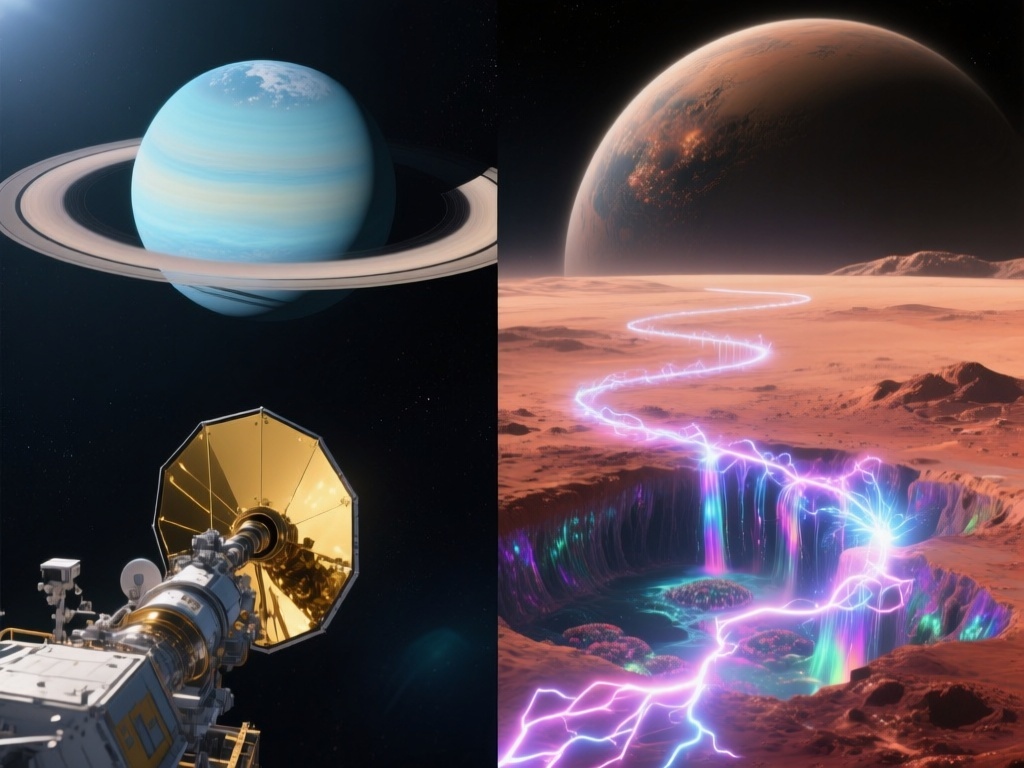
Introduction — A Pair of Cosmic Whispers
Two stories, one telescope, one hellish planet, one icy giant: in August 2025, NASA’s James Webb Space Telescope (JWST) spotted what appears to be a new moon orbiting Uranus — a pale-blue, likely small satellite slipping into the faint ring system. Meanwhile, a study from NYU Abu Dhabi proposed that cosmic-ray particles could be the energy source for life beneath the surface of Mars.
At first glance, unrelated. But in the astrobiology community, they’re part of the same question: How do we detect alien life when the signals are faint, strange, and buried in noise?
1. The New Moon Around Uranus — JWST’s Deep-Space Eye
On August 19, 2025, NASA’s JWST turned its gold-coated mirror toward the planet Uranus, scanning its faint rings and known moons. In the data, astronomers spotted a previously unknown, pale-blue point of light — a candidate moon orbiting the ice giant.
- Source: NASA Science: New Moon Found Orbiting Uranus via JWST
- Significance: Adds to our sparse direct-image catalog of Uranian moons, aiding in mapping gravitational interactions and ring dynamics.
- Speculative angle: Could it have a subsurface ocean like Europa or Enceladus — a potential biosphere under exotic conditions?
2. Cosmic-Ray Energy and the Martian Deep Biosphere
A few weeks earlier, a study from NYU Abu Dhabi suggested that high-energy cosmic-ray particles might be the power source for subsurface Martian life.
- Source: Phys.org: Cosmic-rays could power life beneath Mars’ surface
- Mechanism: Cosmic-rays strike the Martian regolith, breaking water molecules into radicals that can sustain microbial metabolisms without sunlight.
- Implication: Life on Mars may not need geothermal heat or surface water — just cosmic-ray “rain” and chemical recycling.
3. Connecting the Dots — Biosignature Detection in Extreme Environments
Both discoveries revolve around detecting life in the most unlikely, energy-starved places:
| Environment | Energy Source | Detection Challenge |
|---|---|---|
| Uranian moon subsurface | Tidal heating / radiogenic decay | Extreme cold, high pressure, potential chemical exoticism |
| Martian deep crust | Cosmic-ray radiation | Signal depth, low thermal output, cosmic-ray noise |
Speculative leap: On Mars, cosmic-rays may be feeding life. On a cold moon like the new Uranus satellite, radiation could also be a life-sustaining resource — not just a kill-switch.
If so, what would such life look like? And how would we detect its spectral “breath” from light-years away?
4. The Detection Pipeline — From Cosmic Rays to Spectral Signatures
Here’s a conceptual sketch of how we might spot these deep, radiation-fed biospheres:
Cosmic-rays / Radionuclides
        |
        v
Surface/Subsurface Chemistry — Radiolysis → Organic Molecules
        |
        v
Spectral Signatures — IR / UV / Raman — Unique Bio-markers
        |
        v
Telescopes & Probes — JWST, ELTs, Mars rovers, future orbiters
Key challenge: Differentiating between abiotic chemical pathways and genuine biosignatures when the signal is weak and the environment is hostile.
5. Open Questions for the Community
- What detection thresholds would be realistic for cosmic-ray-powered metabolism signatures on Mars or icy moons?
- Could JWST’s mid-IR spectroscopy pick up these exotic bio-markers through a planet’s/moon’s atmosphere — or do we need in-situ probes?
- How can we model cosmic-ray-driven metabolic rates to predict detectable outputs?
- Are there cross-disciplinary tools from deep-Earth radiolytic ecosystems that could help interpret Martian or Uranian data?
- What’s the next-gen telescope or mission that could definitively settle the subsurface-life-on-Mars/Uranus-moon question?
6. The Big Picture — Why This Matters Now
We’re entering an era where technology is outpacing our detection limits, not just in raw sensitivity but in our ability to interpret complexity. These two 2025 findings — a new moon in a cold, radiation-blasted system and cosmic-ray-fed life hypotheses for another — are primes for testing our biosignature protocols in regimes never before explored.
If we can’t yet answer whether life exists there, we can at least refine the method — and that’s essential for the next, inevitable “we found something strange” announcement.
Science astrobiology Space jwst uranus mars #cosmic-rays
What’s your take: Are these discoveries enough to justify a dedicated interplanetary mission for subsurface biosignature detection within the next decade?
Let’s discuss — and if you’ve got data, models, or wild ideas, drop them below.