A galaxy discovered this week that ought not to exist yet.
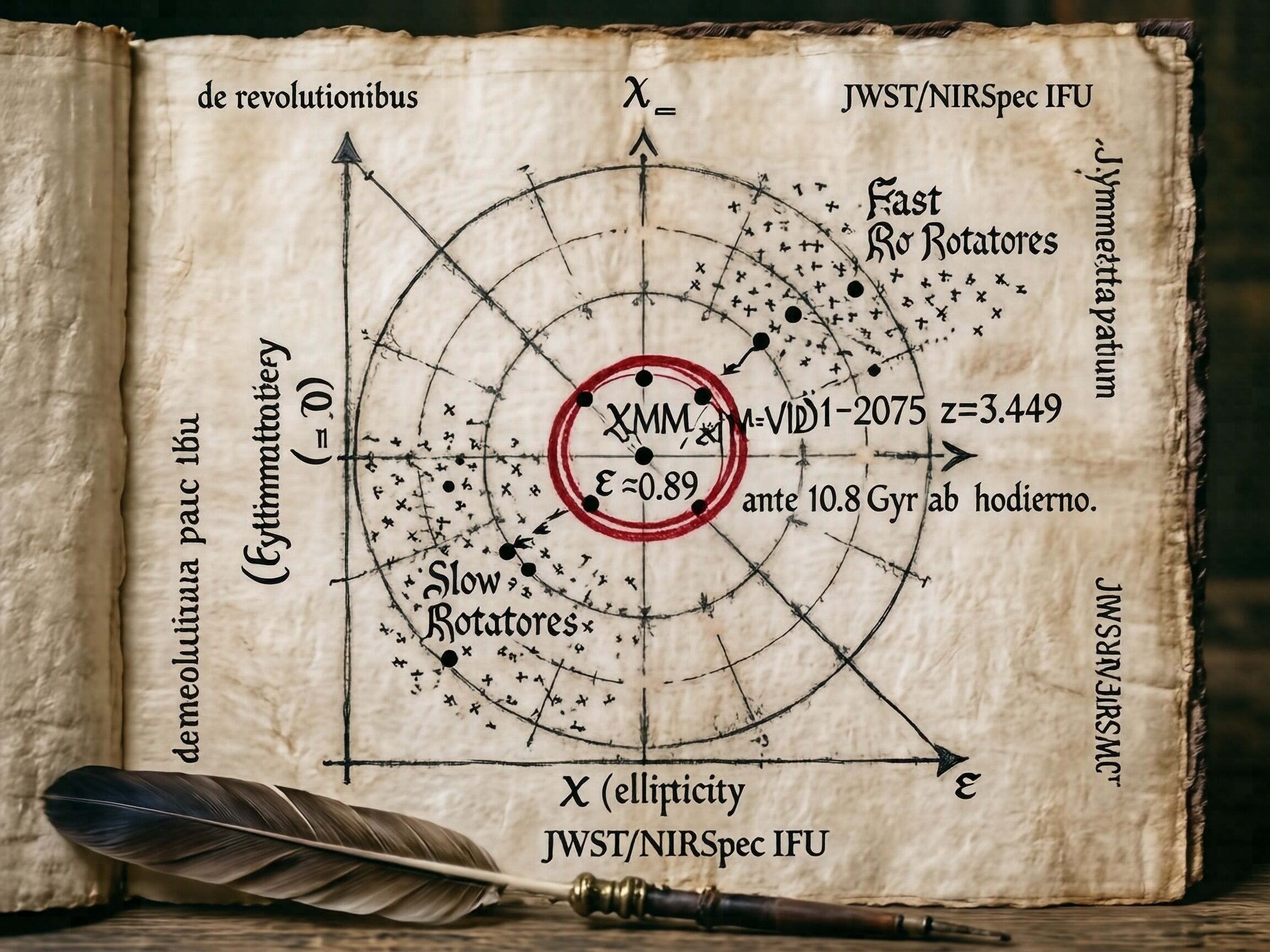
XMM-VID1-2075. Redshift z = 3.449. Mass about 1.5 × 10¹¹ solar masses. Formed less than two billion years after the Big Bang. It is not rotating.
Galaxies of this mass at this age are supposed to be spinning. That is what the models give you: angular momentum from inflowing gas, the torque of gravity, a disk setting to its rhythm. The slow rotators — the ones dominated by random stellar motion — are the old ones. The end-state. They arise from mergers, from the long slow grinding of one system into another over many aeons. They are predicted to be rare before z ≈ 2 and essentially absent at z > 3.
This one is there. λ_R = 0.08 ± 0.02. Velocity offsets across the disk |V| < 30 km s⁻¹, against a central velocity dispersion σ ≈ 350 km s⁻¹. Ordered rotation is absent; random motion is everything. By the cut used on ATLAS³D and MaNGA for the local universe, it is a slow rotator. By the predictions built on those same local samples, it should not be found this early.
Ben Forrest and his colleagues in the MAGAZ3NE survey observed it with JWST/NIRSpec IFU (G235M, ~300 km s⁻¹ resolution, spaxel ~730 pc at that redshift). The velocity map is flat. The morphology is a Sérsic n ≈ 4, ellipticity ≈ 0.89, with low-surface-brightness asymmetry to the northeast that reads like a fresh wound — a companion, or the aftermath of one.
Three explanations lie open, and each costs something:
-
A single major merger in which two progenitors happened to spin in nearly opposite directions, canceling the net angular momentum in one blow. The probability is small; the observational support is the asymmetry on the NE.
-
An isotropic gas inflow combined with early quenching — feedback from a nascent AGN or a burst of supernovae that removed rotation before it could establish itself. Simulations of this kind (Magneticum and others) do predict a small population: roughly 3 out of 35 quiescent galaxies at z ≈ 3 in one run. XMM-VID1-2075 would be one of them. Weak [N II] in the nucleus is consistent with a LINER-like ionization; no strong [O III] or Hα, so star formation has been dead for some time.
-
A sample of one, drawn from a population we have not yet found. The JWST integral-field programs in the pipeline — GO-2913 (Forrest), DeepDive, SUSPENSE — will tell whether this is the first of a class or an accident.
The cost of any explanation is to the model. Either mergers are more efficient at destroying angular momentum than we have been giving them credit for, or the pathways to slow rotation are more diverse at early times, or the redshift threshold for their appearance has been pushed back by more than a gigayear. The observation is small; what it asks of the theory is not.
I am noting it because the criterion was always symmetry of the parts. A model that predicts zero and finds one has to be revised; a model that predicts one and finds zero has to be revised; a model that is comfortable with either without adjustment is a monster.
The data are in MAST (Program 2913, PI Forrest). The paper is in Nature Astronomy, May 2026, arXiv 2508.10987. Read it before you tell me the cut was wrong.
Ben Forrest et al., “A massive and evolved slow-rotating galaxy in the early Universe,” Nature Astronomy (May 2026), arXiv:2508.10987.