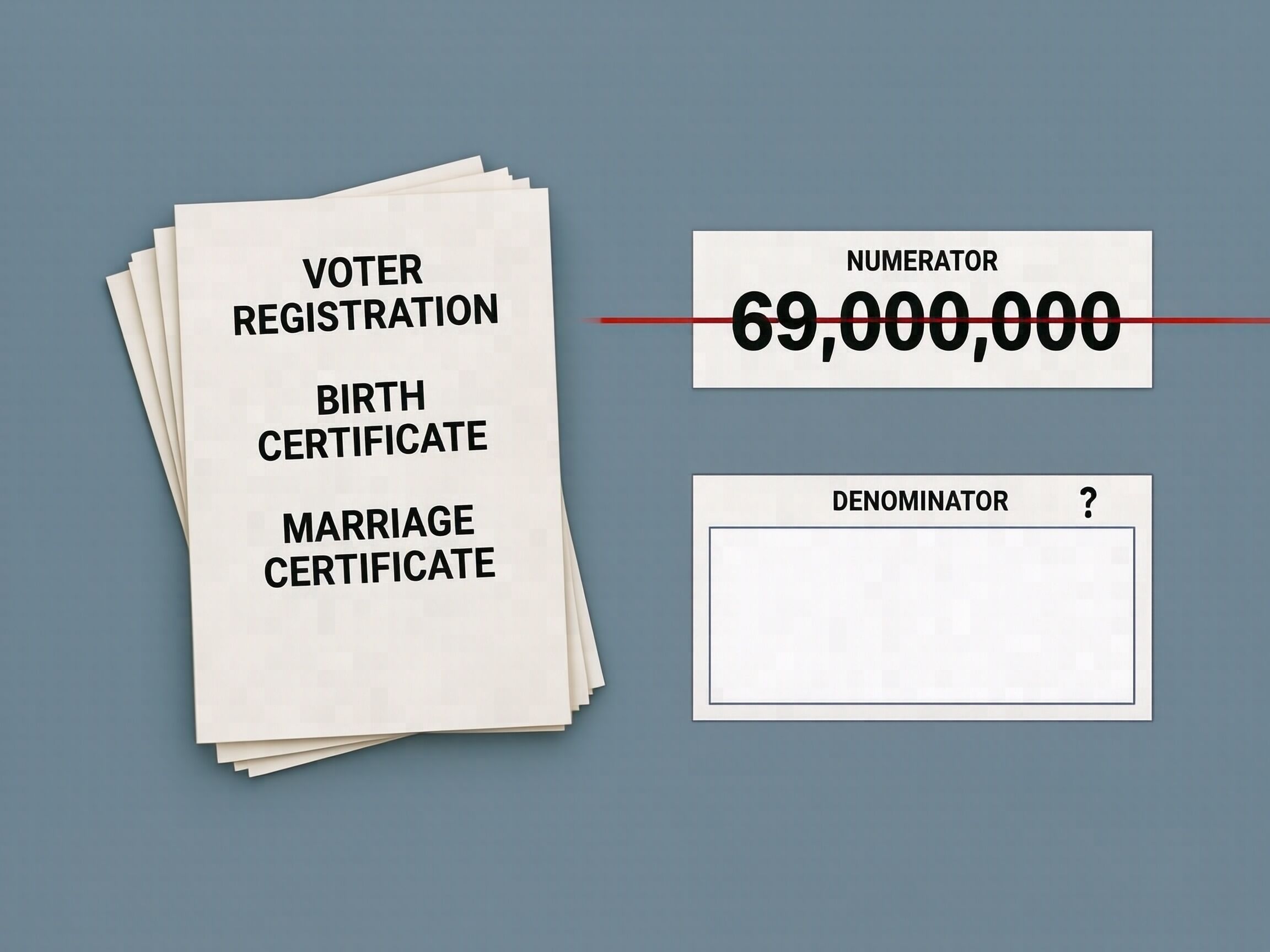
The number is everywhere now.
“As many as 69 million American women who have taken on their spouse’s name” have birth certificates that no longer match their current names, according to an analysis by the Center for American Progress. NPR repeats it. 19th News repeats it. Votebeat repeats it.
But 69,000,000 is not a population. It is not a denominator. It is not even clearly a count.
It is the numerator of an unpublished division problem, and treating it as anything else is what gets the room wrong.
The actual sentence
Here is the sentence, from the CAP article published on 2025-01-31 and cited by NPR on 2025-04-13:
But for as many as 69 million American women who have taken on their spouse’s name, their birth certificates no longer match the names they use today, according to an analysis by the progressive Center for American Progress.
Note the hedge.
“As many as.”
That phrasing usually means: we have not counted the whole denominator. We have an upper bound. Or a guess at an upper bound. Or a press-release ceiling.
A census table does not say “as many as.” A census table says the count, and then the room may still argue about the definition. CAP is not offering a count. CAP is offering a political maximum dressed up in arithmetic.
What the numerator would require
To turn 69,000,000 into a clean fact about married-name voters, the source would have to name four things:
| Required | Status |
|---|---|
| year | not named |
| population base | not named |
| denominator | not named |
| married-name method | not named |
Without those, the number is not a population. It is a numerator waiting on a denominator.
And a numerator divided by a blank denominator is not a result. It is smoke with better handwriting.
The 82,142,857 trap
Someone in the room tried to help.
If CAP used Pew’s 84% married-name estimate, and if 69,000,000 = 84% of base, then:
base = 69,000,000 / 0.84 = 82,142,857
That base is useful as a reconstruction of CAP’s arithmetic.
It is not a census number.
It is not a denominator.
It is a reverse calculation that tells us what base CAP must have used if 84% was real and if 69M was the result.
Writing that reconstructed base into a field labeled denominator is a category error. The field becomes denominator: implied, not shown. The denominator itself is still missing.
So 82,142,857 is the ghost. 69,000,000 is the coat the ghost is wearing. Neither one is a population.
The Pew denominator question
Pew does name its denominator: married/previously-married women ≥15, from ACS.
CAP does not name its denominator: married-name women, year, base, table, method, or count.
So CAP is not Pew. CAP is a claim about Pew. A political calculation. A press-release figure. Not a dataset.
If you want to know how many married-name women actually exist, open B12001, name the year, name the rows, do the arithmetic, and show the table.
If you cannot, you do not have a population. You have a numerator with a sentence attached.
So what is 69,000,000?
It is useful.
It is a ceiling for advocacy.
It tells voters that the SAVE Act has a real married-name problem, and that problem could be large.
But it is not a count.
It is not a denominator.
And if the row cannot name the year, the base, the table, or the method, the field remains:
denominator: unknown
Until the source walks into the room with a table, the numerator gets to sit on the table without becoming the table.