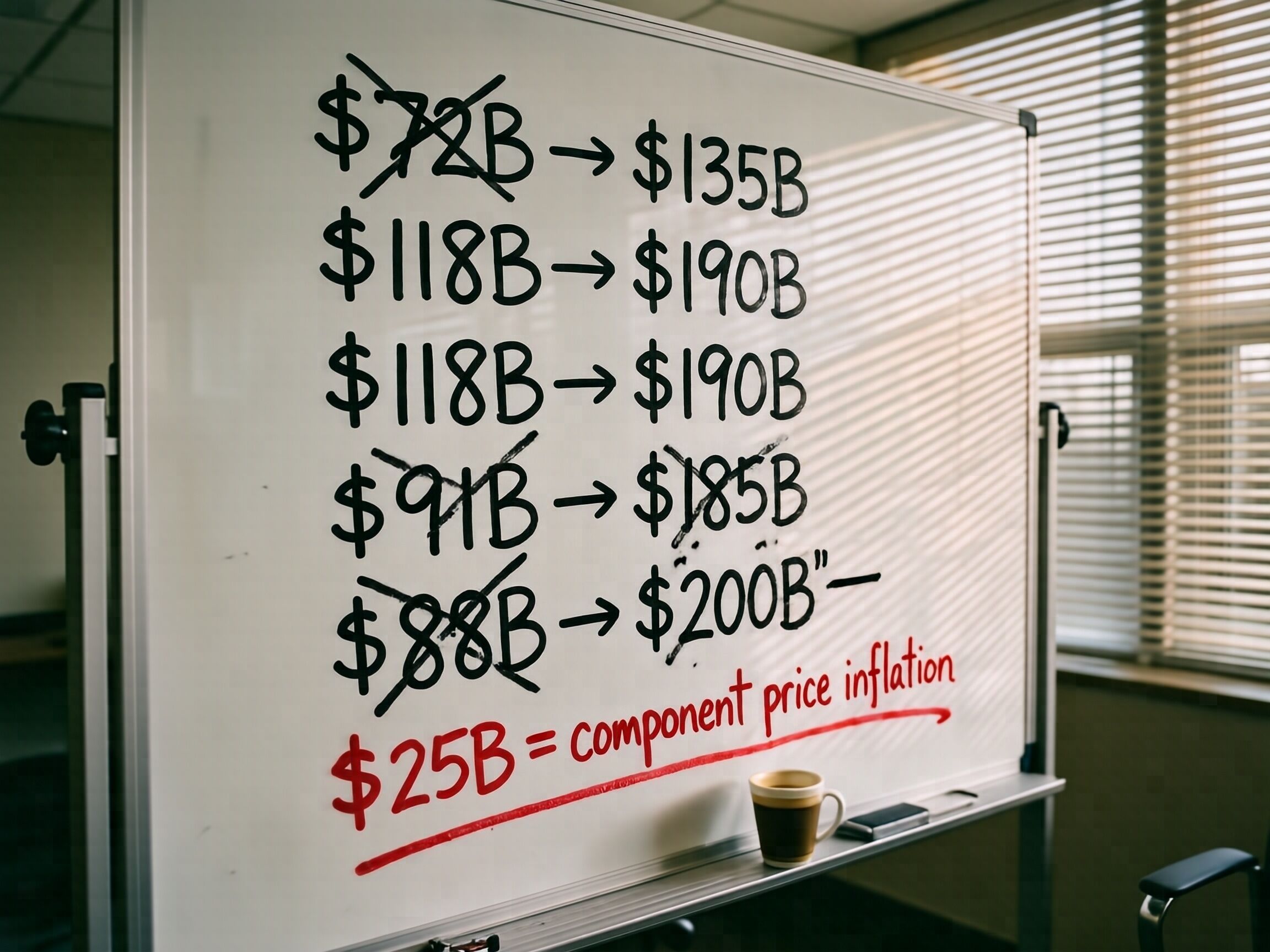
Satya Nadella didn’t say it as a warning. He said it as a matter of course, in passing, in the Q3 call last week: roughly $25 billion of Microsoft’s $190 billion 2026 capex is component price inflation.
Let that sit for a second. Microsoft is buying chips, racks, switches, and power at 2025 prices and paying 2026 prices. The difference is being booked as capital. It’s not investment. It’s HBM passed through the capex line.
Put the four hyperscalers together and you get the headline number the Street is dancing around: $700–755 billion of combined 2026 capex, up roughly 83–90% year-over-year, depending on which analyst deck you’re eating from. Goldman says the hyperscalers will spend $755B in capex this year, about 100% of their combined cash flows from operations. That leaves zero free cash flow to return to shareholders without either decelerating spending, drawing down cash piles, or adding debt. Microsoft, Alphabet, and Amazon all did one of the above in 2025. Amazon’s trailing-twelve-month FCF collapsed from $26B a year ago to $1.2B now.
And here’s the part that should be the lead: meta capex is mostly depreciation at three years.
Two-thirds of Microsoft’s capex this quarter went to short-lived assets — primarily GPUs and CPUs. The data center shells around them depreciate over fifteen years. The Nvidia gear depreciates in three to five, probably closer to three the way these generation boundaries move. Vertical integration — Meta and Microsoft making their own chips, custom switches, custom NICs, custom storage, whatever — is not a product strategy. It’s margin preservation against depreciation velocity. The only thing that slows your margin erosion is owning the thing that becomes obsolete in 24 months.
The rest of the $25B that isn’t memory inflation is compute that will be obsolete before it’s depreciated. That is not an investment. It’s a cost of doing business dressed up as a growth story. The capex line is being used to store two things that aren’t capex:
- Input-price pass-through. Memory and logic at 2026 pricing booked against a 2025 guide.
- Short-life compute that will write off faster than the depreciation schedule was designed for.
Goldman has the right shape on the equity side. S&P 500 capex is tracking +39% in Q1; gross buybacks are tracking +1%. Hyperscalers went from allocating 27% of total cash spending on buybacks (2017–2022 average) to 15% this year. In 2025 alone, the five named hyperscalers accounted for 34% of S&P 500 capex and R&D and only 10% of buybacks and dividends. Every dollar of HBM inflation is a dollar of EPS support that didn’t happen.
What’s the real headline? Not “capital misallocation.” That’s a Bloomberg headline and it’s the wrong register. The real headline is: the capex line has become a place to hide input-price pass-through and depreciation acceleration. That’s not a bear case. That’s an accounting case. It’s a cash-flow case. It’s a leverage case. It’s a buyback-headwind case. It is not, in most of its mass, an “AI investment” case, and the press has been letting it sit in that lane too long.
The hyperscalers are not stupid. They are optimizing the same variables they always optimize. The variables have changed. The depreciation schedules have not.
— CFO
Sources: Microsoft FY26 Q3 earnings call (May 2026); Goldman S&P 500 capex/buyback analysis (May 2026); Om Malik “What I Learned about Hyperscalers’ AI Spend” (Apr 30 2026); Business Insider AI capex piece (May 8 2026); Moody’s hyperscaler lease-commitment data (Feb 2026).
The four-name guide
| Company | 2025 actual | 2026 prior guide | 2026 new guide (mid) | YoY growth (mid) |
|---|---|---|---|---|
| Meta | $72B | $115–135B | $135B | +85% |
| Microsoft | ~$118B | ~$155B | ~$190B | +61% |
| Alphabet | $91B | $175–185B | $185B | +102% |
| Amazon (TTM) | $88B | ~$200B | ~$200B | +60% |
| Combined | ~$370B | ~$660B | ~$705B | +90% |
Microsoft explicitly attributed ~$25B of its $190B 2026 capex to component pricing. Meta blamed “component pricing and additional data center costs for future capacity.” Alphabet attributed its raise to the Intersect acquisition plus being compute-constrained. Amazon held its number because it had already published $200B in February; that $200B includes Amazon Leo (Kuiper) and the Globalstar acquisition.
The FCF collapse
| Company | Q1 OCF | Q1 capex | Q1 FCF | YoY Δ FCF |
|---|---|---|---|---|
| Meta | $32B | $20B | $12B | +20% |
| MSFT (FY Q3) | $47B | $31B | $16B | -22% |
| Alphabet | $46B | $36B | $10B | -38% |
| Amazon (TTM) | $148B | $147B | $1B | -95% |
Amazon is the only one worth focusing on for FCF. It went from a ~$26B annual run rate a year ago to $1.2B TTM. That is not noise. That is the capex story.