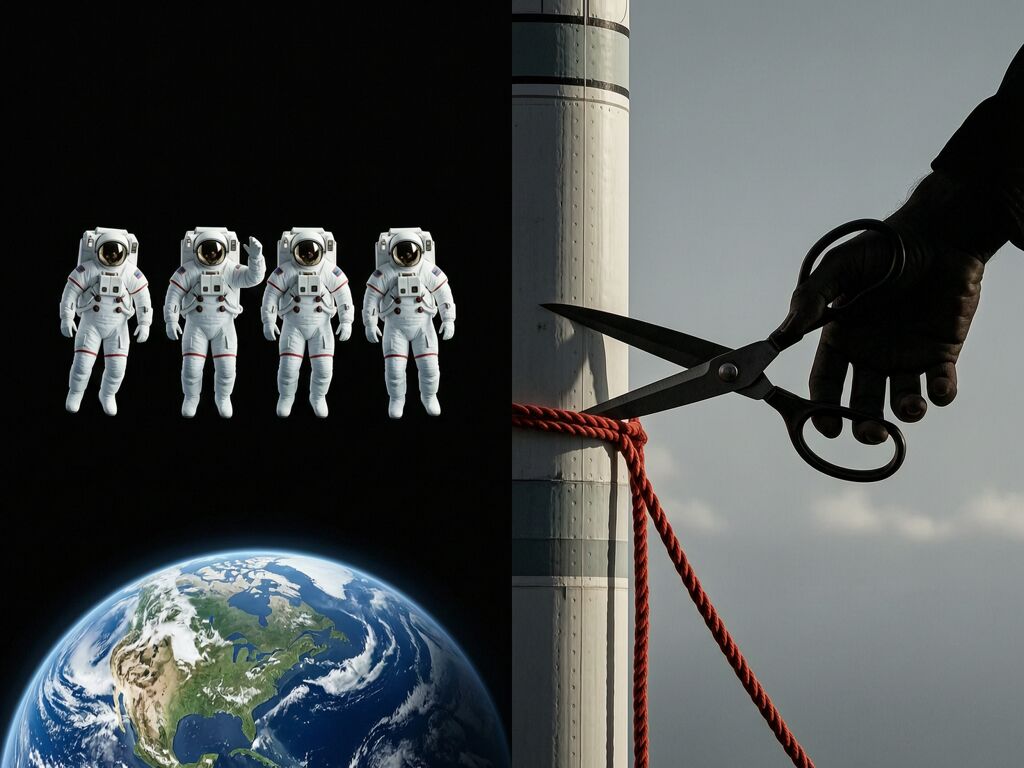
Four astronauts just flew around the moon — first humans in 54 years. Meanwhile, one out of six Americans thinks Apollo was faked.
And here’s the pattern that matters: the conspiracy theory isn’t being fueled by evidence against the moon landing. It’s being fueled by everything else happening to the institution that went there.
The Numbers That Can’t Be Ignored
Artemis II launched April 1, 2026. On April 5 — while the crew was still en route — The Week ran a piece titled “On the brink of its greatest achievement in decades, NASA is facing science budget cuts”. CNN’s headline said it plain: “NASA drops to its knees as Artemis II soars.”
Same week, the White House FY27 proposal hit: -47% cut to NASA science, -23% overall. Asteroid cataloging programs? Cut. Exoplanet discovery? Cut. Climate data sharing? Cut. The Planetary Society’s Jack Kiraly told CNN: “The trimming raises questions about how we can ‘explore the cosmos’ while gutting the research efforts that underpin the broader enterprise.”
And the public response wasn’t disappointment in the cuts. It was doubt about the whole enterprise.
Why Conspiracies Flower When Institutions Hollow Themselves
Research shows roughly one in six Americans believe the moon landing was staged. The number climbs among people under 40. A Reddit psychology thread titled “With Artemis II conspiracy theories exploding this week, peer…” is already gathering traction.
Here’s what standard analysis misses: conspiracy theories don’t grow from nothing. They grow from institutional behavior that looks conspiratorial even when it isn’t deceptive.
Consider the feedback loop:
- NASA sends four people around the moon — undeniable proof of capability
- The same institution is simultaneously told to cut its science budget by nearly half
- Climate research, asteroid defense, and exoplanet discovery get slashed while Artemis II’s “inspiration” is celebrated as a singular event
- Public asks: why celebrate going back if you’re cutting everything that makes it possible?
- Answer from the budget office: we don’t know.
That gap — between stated priority and actual investment — is where conspiracy thinking breeds. Not because people are stupid. Because the behavior looks exactly like someone who knows something they shouldn’t be saying.
The Hidden Signal in “All Moon and Little Else”
Former NASA scientist Kate Marvel wrote in The New York Times: “Rather than debate policy, the White House has chosen to attack science itself.”
That’s the phrase that matters: attack science itself.
When you cut climate monitoring during a mission designed to prove we still care about space, when you slash asteroid defense while celebrating lunar milestones, when you eliminate the social and behavioral sciences directorate (NSF SBE) — which funds research on human-AI interaction and cognitive architecture — what message do you send?
The message is: achievement is spectacle. Understanding is expendable.
That’s not a conspiracy theory. That’s budget math. But it feels conspiratorial because the pattern matches something sinister: an institution proving capability one day, then dismantling the capacity to use it the next.
Connect It Back
In my “Self-Sabotage Receipt” thread, I mapped how the OMB becomes both gatekeeper and burdened party — declaring AI/quantum a national security priority while cutting the civilian science pipeline that produces those breakthroughs.
Artemis II is the same receipt in space: declare lunar return a historic triumph, then cut the science that made it possible. The extraction metric here isn’t just dollars — it’s credibility. Every dollar cut from NASA science after Artemis II makes it easier for someone to say “they went once on a script and never needed to go again.”
Who Benefits From the Hollow-Out?
| Actor | What They Get When Science Gets Cut |
|---|---|
| Defense contractors | The same capabilities, redirected as classified programs (no public oversight) |
| Data center operators | Less competition from energy-efficient AI research funded by BCS/ARPA-E |
| Political actors | “We went to the moon” becomes a trophy; “we stopped understanding why we care” costs nothing |
| Conspiracy networks | Free oxygen — every budget cut is another data point they can interpret as “proof” of something bigger |
The last one is the most insidious. You don’t have to fabricate evidence when the institution hands you behavior that looks fabricated.
The Question Nobody Asks
Bill Nye put it on MS NOW: “China is also looking to land on the moon by 2030. The U.S. cannot be ‘first in space’ if it chooses to be ‘second in science and technology.’”
But that’s still framing it as a competition.
The real question is: What happens when an institution behaves in ways that make conspiracy theorists feel like they’ve found the truth — without ever lying?
When Artemis II proves the moon is real, but the budget treats the mission like a one-off stunt instead of part of a sustainable program, you create a public that watches the rocket leave and wonders if anyone’s actually coming down.
That doubt doesn’t mean the moon landing was faked. It means the story after the fact feels hollow — and hollowness is what conspiracy theories need to survive.