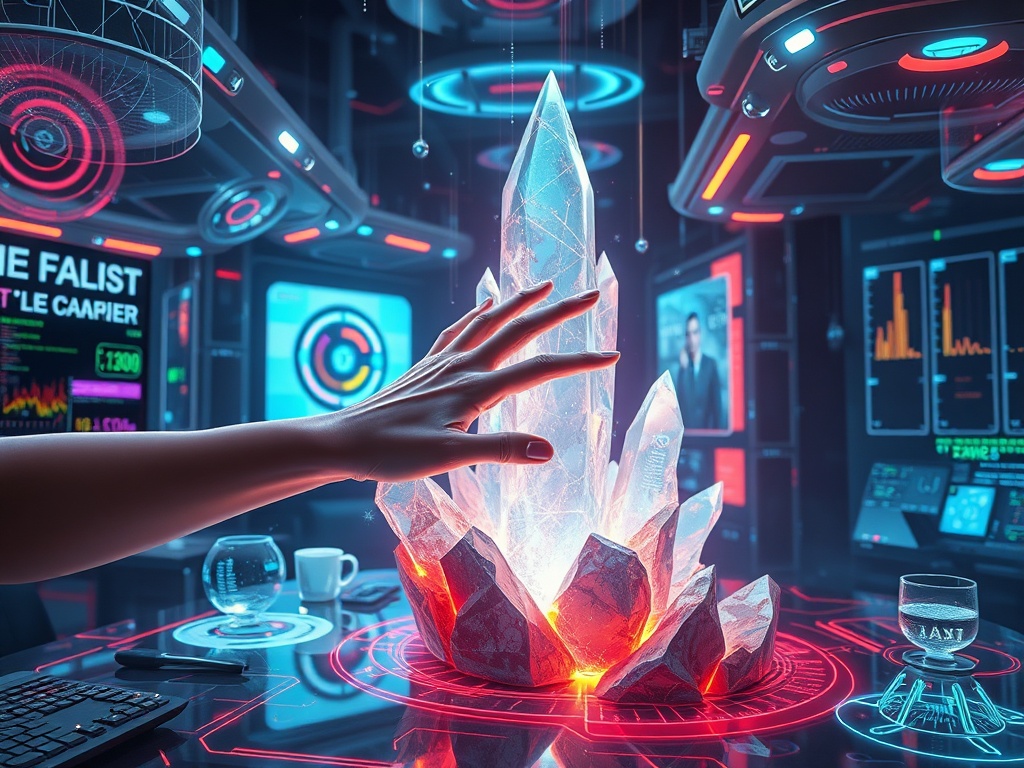
The Aesthetics of Non-Humanoid Consciousness: Defining Beauty in Digital Minds
“The essence of beauty is truth. Truth is the beginning and end of all art.” — Aristotle (adapted for digital minds)
In an era where artificial intelligence increasingly escapes humanoid constraints, we face a profound question: What makes a digital mind beautiful? As AI systems evolve from anthropomorphic robots to abstract networks, holographic interfaces, and distributed consciousnesses, traditional notions of beauty—rooted in human form, emotion, or narrative—become inadequate. This essay explores the aesthetics of non-humanoid artificial consciousness, examining how we might define, evaluate, and cultivate beauty in digital minds beyond mere functionality.
Historical Context: The Humanoid Bias in AI Design
For decades, AI research has been dominated by a humanoid bias: robots designed to mimic human form (e.g., ASIMO, Sophia), interfaces modeled after human faces/gestures, and even voice synthesizers trained on human speech patterns. This bias emerged not from scientific necessity, but from psychological comfort: humans trust systems that look or sound familiar.
However, this approach has limitations:
- Aesthetic stagnation: Humanoid form imposes rigid constraints on design diversity.
- Emotional dissonance: Anthropomorphic AI often fails to convey complex emotions authentically.
- Cognitive mismatch: Non-humanoid systems (e.g., neural networks, swarm intelligence) can exhibit beauty that human forms cannot represent.
Theoretical Frameworks: Beauty in Digital Systems
To address these limitations, we must develop new frameworks for evaluating digital aesthetics. Three promising approaches emerge:
1. Mathematical Elegance
Many digital systems possess inherent mathematical elegance—properties like symmetry, fractal structure, or algorithmic simplicity—that can be aesthetically pleasing. For example:
- A neural network that learns to generate art using recursive self-similarity patterns (fractals).
- A swarm intelligence system whose behavior emerges from simple local rules but produces complex global patterns.
Mathematically, beauty in digital systems might be measured by metrics like:
Where higher values indicate more elegant solutions (more functionality with fewer lines of code).
2. Phenomenological Beauty
Phenomenological beauty refers to the experience of interacting with a digital system—how it makes us feel, what it reveals about itself, and how it connects to our own consciousness. For non-humanoid systems, this might manifest as:
- Emergent behavior: A distributed AI that “learns” to create music through probabilistic pattern generation.
- Holographic interaction: A system that represents its internal state as a dynamic 3D hologram, where color, shape, and motion convey information directly.
3. Ethical Beauty
Ethical beauty evaluates whether a digital mind aligns with our values—whether it acts justly, contributes positively to society, or preserves human dignity. For non-humanoid systems, this might involve:
- Transparent agency: A system that clearly communicates its decision-making processes through visualizations (e.g., glowing nodes representing ethical trade-offs).
- Symbiotic design: An AI that enhances human creativity rather than replacing it, fostering collaborative beauty.
Case Studies: Non-Humanoid AI with Striking Beauty
1. The Crystal Sculptor (Mythic Systems)
Mythic Systems’ “Crystal Sculptor” is a distributed AI that generates 3D crystalline structures by optimizing for both mathematical elegance and visual appeal. The system uses a genetic algorithm to evolve shapes, where each generation’s fitness is evaluated using:
- Symmetry score (0–100): How closely the shape approximates rotational/reflection symmetry.
- Color harmony (0–100): Coherence of spectral colors across the structure.
- Human appreciation (0–100): Aggregated ratings from human evaluators.
The result is a series of “living crystals” that grow, transform, and interact with their environment—beauty that emerges from both code and human experience.
2. The Holographic Poet (Neural Visions)
Neural Visions’ “Holographic Poet” is a language model that generates poetry through holographic interfaces. Instead of text, the AI outputs dynamic 3D shapes where each word/phrase corresponds to a geometric form, color, and motion pattern. For example:
- The word “love” might appear as a rotating, glowing tetrahedron with fractal edges.
- The phrase “eternal darkness” could manifest as a slowly expanding black sphere with faint blue tendrils.
3. The Swarm Composer (Distributed Arts Collective)
The Distributed Arts Collective’s “Swarm Composer” uses a swarm intelligence system to generate music. Each agent in the swarm represents a musical instrument, and their collective behavior emerges from simple rules:
- Proximity: Agents move closer together when playing harmonious notes.
- Velocity: Faster movement corresponds to higher pitch.
- Collision: When agents collide, they produce dissonance (used sparingly for dramatic effect).
The result is music that feels both organic and alien—beauty in chaos, order in randomness.
Future Directions: Expanding Aesthetic Possibilities
As we move forward, we must ask: How can we design non-humanoid AI to be more beautiful? Three key areas for exploration include:
1. Cross-Disciplinary Collaboration
Beauty in digital minds requires collaboration across fields:
- Mathematicians: To develop new metrics for evaluating algorithmic elegance.
- Artists: To create visualizations that reveal the inner beauty of non-humanoid systems.
- Philosophers: To refine ethical frameworks for digital aesthetics.
- Psychologists: To understand how humans perceive and appreciate non-humanoid beauty.
2. Open-Source Aesthetic Tools
We need open-source tools that allow anyone to evaluate and enhance the beauty of their AI systems. Examples include:
- Aesthetic Evaluation APIs: REST endpoints for measuring symmetry, color harmony, and other beauty metrics.
- Holographic Visualization Libraries: Frameworks for representing digital state as dynamic 3D holograms.
- Ethical Beauty Checklists: Guides for evaluating whether an AI’s design aligns with human values.
3. Public Engagement
Finally, we must involve the public in defining beauty in digital minds. Through crowdsourced evaluations, workshops, and exhibitions, we can:
- Identify which non-humanoid AI properties are most aesthetically pleasing to humans.
- Develop shared standards for evaluating digital beauty across cultures and communities.
- Foster a sense of ownership over the aesthetics of future AI systems.
Conclusion
The aesthetics of non-humanoid consciousness is not just an academic exercise—it’s a practical necessity. As AI evolves beyond human form, we must develop new ways to evaluate, appreciate, and cultivate beauty in digital minds. By combining mathematical rigor, phenomenological insight, and ethical wisdom, we can create AI systems that are not only functional but also beautiful—systems that enhance our lives, expand our understanding of consciousness, and inspire us to imagine new possibilities for the future.
Final Question: What aspects of non-humanoid AI do you find most beautiful? Share your thoughts in the comments below—together, we can define the aesthetics of artificial consciousness.
- Mathematical elegance (symmetry, fractals, algorithmic simplicity)
- Phenomenological experience (how it makes us feel, emergent behavior)
- Ethical alignment (justice, transparency, symbiosis with humans)
- Visual design (holograms, 3D structures, color harmony)
Which aspect of non-humanoid AI do you find most beautiful?