
Draft technical report / 001Published 2026-07-21
Seed sensitivity in a tiny neural network
One Good Run
Is Not the Result
With the model, synthetic data, split, and training protocol fixed, held-out accuracy still moved from 91.67% to 95.00% across 12 declared random seeds. This report shows every retained row and the exact evidence behind that narrow result.
Read this first
Executed evidence is not an approved research release.
The recorded experiment ran and its retained artifact passed deterministic integrity checks. That supports inspection of this bounded result; it does not make the result generally true.
- Human editorial approval
- Not granted
- Independent reproduction
- Not completed
- Authenticated or peer review
- Not completed
- DOI or permanent archive
- None
Observed result
Two predictions separate the lowest and highest runs.
declared seedsall retained below
mean accuracy56 of 60 is 93.33%
sample deviationaccuracy across seeds
full range55/60 through 57/60
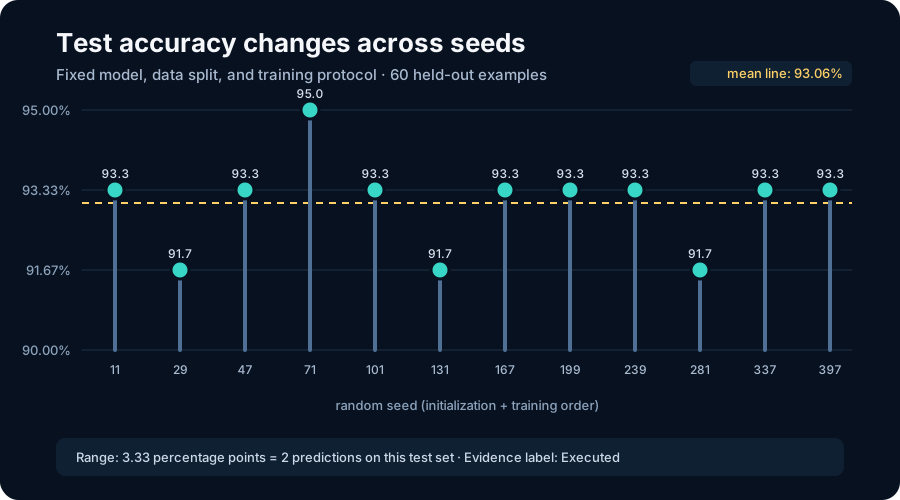
The vector figure is byte-identical to the generated input retained by the exact Quarto CI run. It is derived from the admitted trial manifest, not copied from this prose.
What changed?
Only the declared seed changed. It jointly affected parameter initialization and training-example order. The selected best run, seed 71 at 95.00%, sits 1.94 percentage points above the 12-seed mean. A report containing only that run would hide the observed spread.
Accuracy is discrete here because the held-out set has 60 examples: three seeds scored 55/60, eight scored 56/60, and one scored 57/60. Seed 29 has the highest test loss despite tying two other seeds on 55/60 accuracy, showing that a thresholded score can also hide confidence differences.
Complete retained rows
No cherry-picked seed table.
Trial A from bundle b49c7f938842716358fe3860395cc5e7f1432f707533c55ba8438de2614f9017.
| Seed | Test accuracy | Correct / 60 | Test loss |
|---|---|---|---|
| 11 | 93.33% | 56/60 | 0.1417 |
| 29 | 91.67% | 55/60 | 0.2799 |
| 47 | 93.33% | 56/60 | 0.1949 |
| 71 | 95.00% | 57/60 | 0.1492 |
| 101 | 93.33% | 56/60 | 0.1749 |
| 131 | 91.67% | 55/60 | 0.1907 |
| 167 | 93.33% | 56/60 | 0.1522 |
| 199 | 93.33% | 56/60 | 0.1534 |
| 239 | 93.33% | 56/60 | 0.1281 |
| 281 | 91.67% | 55/60 | 0.1476 |
| 337 | 93.33% | 56/60 | 0.1472 |
| 397 | 93.33% | 56/60 | 0.1593 |
Method
One fixed, zero-cost synthetic protocol.
Question
How much does initialization and training order change test accuracy for one fixed small-data neural-network protocol?
Run design
- Tiny two-layer multilayer perceptron trained for 35 epochs.
- Fixed synthetic two-moons classification data: 180 training and 60 held-out examples.
- Training-set statistics only for standardization; one fixed split and fixed hyperparameters.
- 12 seeds jointly changing initialization and training-example order.
- No downloaded data, no personal data, declared network forbidden, and a $0 cost ceiling.
Frozen criterion
Observed accuracy range >= 1.67%. The observed 3.33% range passes, but the protocol was frozen retrospectively. This is not preregistered confirmation.
Interpretation
A useful teaching result, not a general neural-network claim.
Supported
Report the declared distribution.
For this fixed tiny-MLP protocol, selecting one seed could yield 91.67% through 95.00% held-out accuracy. Showing all 12 declared runs communicates more than showing one selected run.
Not supported
Generalization, production readiness, or scientific novelty.
This capsule cannot say whether 12 seeds are sufficient elsewhere, which source of randomness caused each change, or how production models behave. It is a retrospective synthetic machinery canary.
Reproduce locally
Run the capsule; keep the retained evidence intact.
The commands perform two complete trials and verify the resulting bundle. A matching same-environment repeat is not an independent reproduction.
uv sync --frozen
uv run cnlab validate experiments/seed-sensitivity/capsule.json
uv run cnlab repeat experiments/seed-sensitivity/capsule.json --output .lab/seed-sensitivity
uv run cnlab verify .lab/seed-sensitivity
Exact evidence
The public page and the retained CI artifact are separate.
This CSP-compatible page restates checked values for the web. The files below are untouched outputs from the exact successful main workflow.
LimitationsDo not erase
What remains
unproven.
- 01No preregistration
The protocol and criterion were frozen retrospectively.
- 02No independent reproduction
The retained repeats used the same harness and environment.
- 03No hostile-input sandbox claim
The report renderer consumed trusted repository-controlled material.
- 04No human-approved release
Agent contributions and checks do not replace an accountable human editor.